
Board Brief
April 2026
Designed for Club Board of Directors
Inside this Issue:
-
Insights: Would I Join My Club Today? A Viewpoint on Initiation Fees in the Post-Pandemic Era
For many private clubs, the years following the pandemic felt like a long-awaited reversal of fortune. -
By the Numbers: Operating Ledger Focus—Ensuring Dues Revenue Covers Operating Costs
A primary concern in club financial management is ensuring that dues revenue is sufficient to cover operating expenses. -
Best Practices: Private Club Boards Leading with Purpose: The Responsibility of Service
Serving on a club board of directors is often described as an honor. In practice, it is a leadership responsibility with a lasting impact on culture, continuity, and the member experience. -
External Influences: Leaning into Employee Safety
From evolving member expectations to advancements in technology and operations, a lot has changed in the club industry over the past 22 years. -
CMAA News & Announcements: Understanding the Competency Areas in Club Management
CMAA’s educational curriculum is based on competency areas covering every aspect of a club management professional’s job and responsibilities. -
CMAA News & Announcements: Upcoming Governance & Leadership Symposium on April 15
Designed for our West Coast attendees, this program will run from 9:45 a.m. to 4:30 p.m. Pacific Time (PT). Attend from anywhere with an Internet connection.

Insights
Would I Join My Club Today? A Viewpoint on Initiation Fees in the Post-Pandemic Era
For many private clubs, the years following the pandemic felt like a long-awaited reversal of fortune. Demand returned with force. Waitlists reappeared. Initiation fees rose, sometimes incrementally, sometimes dramatically. In many cases, momentum built faster than anyone expected. For boards and leadership teams, it was reassuring. For some, it was even celebratory.
Yet amid that momentum, one fundamental question often went unasked. Would I want to and be able to join my club today at today’s initiation fee? Not as a board member. Not with years of emotional investment and institutional knowledge. But as someone encountering the club for the first time. That question has a way of cutting through optimism and getting to the heart of stewardship.
From roughly 2010 through 2019 initiation fees across much of the industry moved cautiously. Growth was measured. Many clubs were still recovering financially and psychologically from the Great Recession. Then the pandemic altered how people think about time, community, wellness, and shared experience. Private clubs shifted from being “nice to have”, to being deeply relevant. For many families they became anchors of routine, identity, and belonging. Demand did not simply return. It reset expectations.
Between 2020 and 2025 initiation fees at the median club increased at nearly twice the pace of general inflation, tracking more closely with home price appreciation than CPI. That distinction matters because it tells us initiation fees are no longer just keeping up with costs. They are repositioning the club itself.
Initiation fees play a meaningful role in capital planning in many clubs today. They help stabilize debt, support deferred maintenance, and reduce the need for assessments or sharp dues increases. None of that is inherently problematic. But in some clubs, initiation fees now represent most of the capital income, and in a growing number of cases they account for more than 75 percent. At that point, initiation fees are no longer a supplement. They are the plan. When capital depends heavily on initiation fees the future of the club becomes tied to the next member paying more than the last. That is a strategic choice whether it is explicitly acknowledged or not. It also raises a deeper governance question. Are we pricing access to protect the experience, or are we financing operations through turnover?
As initiation fees rise quickly, many clubs begin to develop two very different member experiences. There are tenured members who joined under a far lower economic threshold and newer members who arrive having written a much larger check. Over time that gap can surface in subtle ways. Expectations around service. Perspectives on assessments. Different definitions of value and fairness. The issue is not whether higher initiation fees are justified. Often, they are. The issue is whether the board has intentionally reconciled what that price signals about who the club is for and how members are meant to relate to it. Culture rarely changes abruptly. It drifts quietly, shaped by incentives, assumptions, and unspoken norms.
Most boards ask reasonable questions. What are peer clubs charging? How long is our waitlist? What will the market bear? Those questions matter, but they tend to focus on capacity rather than character. The more revealing question is simpler. Would I join my club today if the initiation fee were $XXX? That question changes the conversation. It shifts attention from what the market allows to what the club represents. It forces reflection on accessibility versus exclusivity, on confidence versus complacency, and on whether pricing reflects the experience being delivered or simply the moment being lived.
The clubs navigating this period most effectively are doing a few things intentionally. They benchmark initiation fees against real assets and member demographics, not just peer clubs. They stress test capital plans for slower turnover and pricing normalization. And they talk openly about who the club is today and who it intends to be in the future. Initiation fees send a powerful signal. They communicate value, belonging, and identity. The question is whether that signal is being shaped deliberately or inherited passively from market conditions.
The post-pandemic surge gave private clubs something rare: leverage. The clubs that will endure are the ones that use that leverage not only to increase initiation fees, but to increase clarity. Because in the end the most honest test of long-term health may still be the simplest one. Would I choose to join my club today?
Insights by Aaron Dawson, CCM, Founder, Viewpoint EQ

By the Numbers
Operating Ledger Focus—Ensuring Dues Revenue Covers Operating Costs
From July 2024-June 2025, CMAA and Club Benchmarking collected data from more than 1,200 clubs for the 2024 Club Finance and Operations Survey. In this edition of Board Brief, we will dive into understanding the role dues play in a club’s operating ledger.
A primary concern in club financial management is ensuring that dues revenue is sufficient to cover operating expenses. Clubs typically operate with high fixed costs, and these expenses are closely tied to the scale of the club’s facilities.
Regression analysis confirms that 73 percent of the variation in operating dues revenue between clubs can be attributed to differences in the value of gross assets, including buildings and equipment. This underscores the importance of aligning dues revenue with the club’s physical and operational footprint.
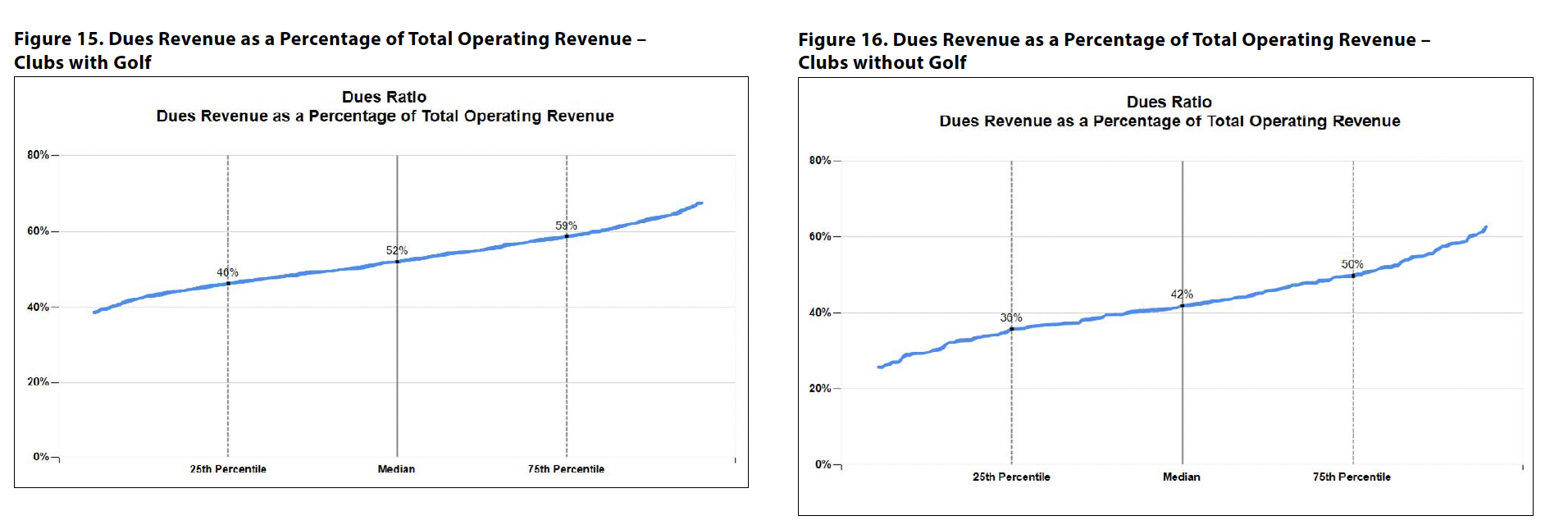
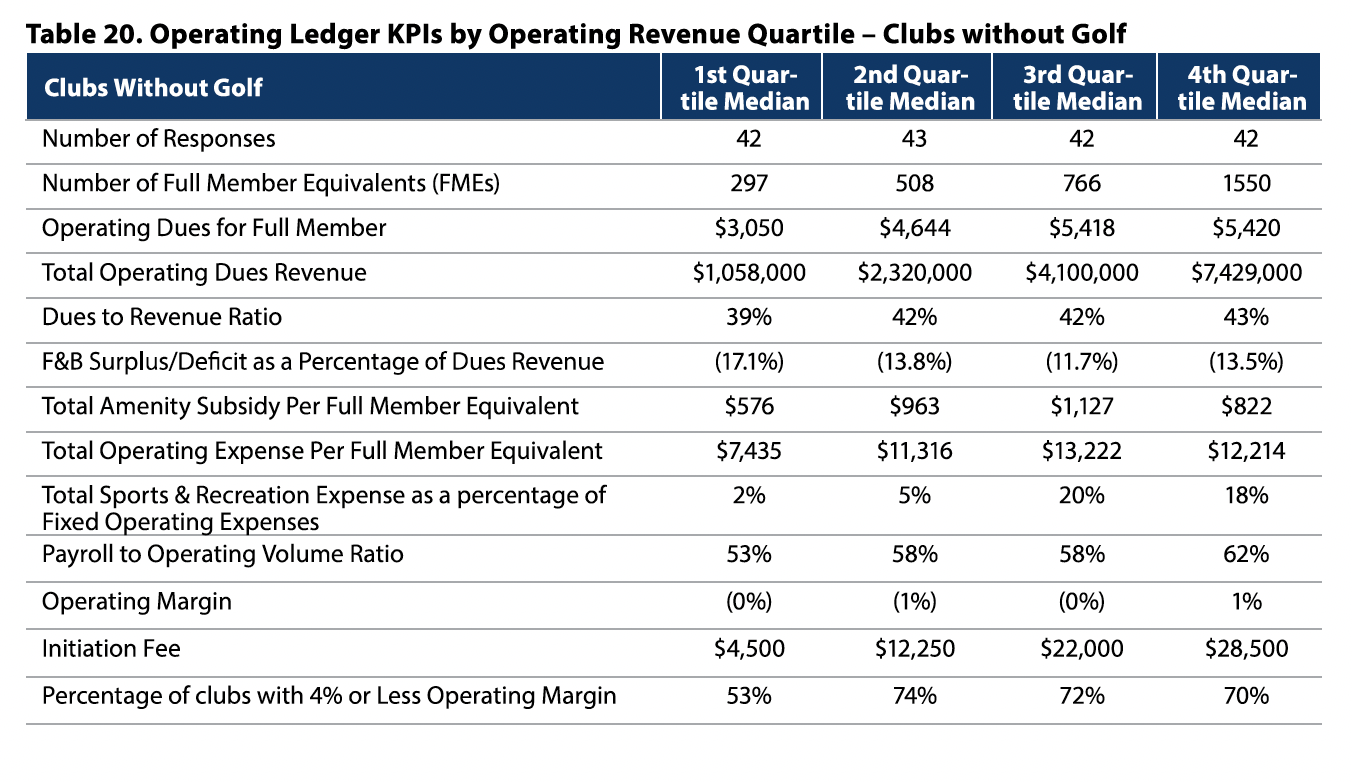
One of the most important KPIs for evaluating this alignment is the Dues to Operating Revenue Ratio, illustrated in Figures 15 and 16 for clubs with and without golf, respectively.
Evaluating Member Experience Through Operating Ledger KPIs
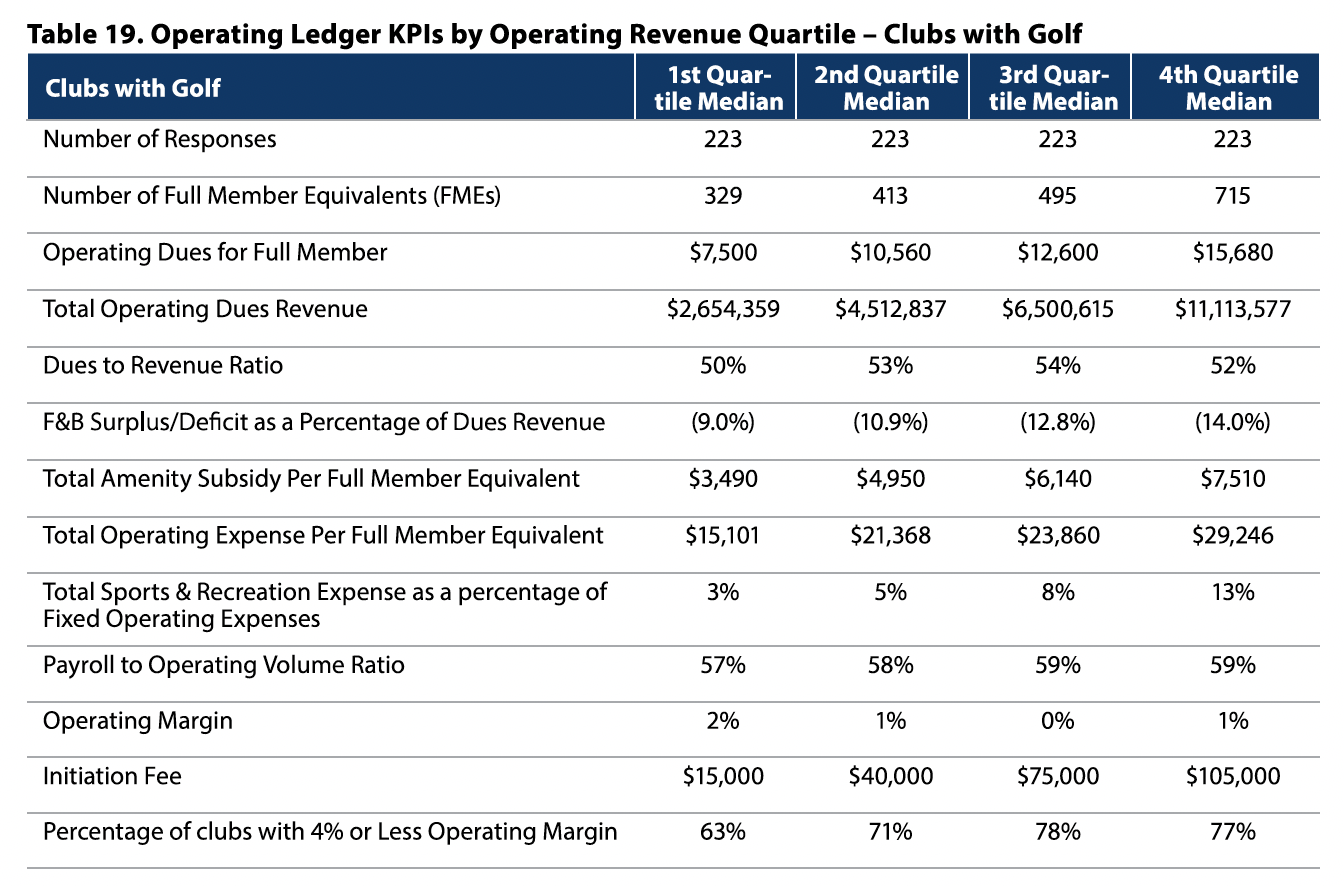
Tables 19 and 20 present operating ledger KPIs that reflect the quality and scope of the member experience. These metrics are not intended to standardize clubs or push them toward a one-size-fits-all model. Instead, they provide data-driven insights that help club leaders evaluate whether their current member experience is aligned with the club’s strategic goals and financial potential.
It is important to note that not every club is expected to fall into the top quartile for operating revenue. Success is defined by how well a club uses its resources to deliver value to members, not by how it compares to others in absolute terms.
Operating Ledger KPIs by Revenue Quartile
Tables 19 and 20 present a comprehensive view of operating ledger KPIs segmented by operating quartiles for clubs with golf and clubs without golf, respectively. Despite differences in club type and size, the patterns across both tables are strikingly similar.

Best Practices
Private Club Boards Leading with Purpose: The Responsibility of Service
Serving on a club board of directors is often described as an honor. In practice, it is a leadership responsibility with a lasting impact on culture, continuity, and the member experience. For general managers, the quality of board leadership often determines whether progress feels steady and aligned or fragmented and reactive.
Effective board service today requires discipline, clarity of role, and a shared understanding of what stewardship means in a member-owned organization. The strongest boards recognize that they are temporary caretakers of something that must outlast their individual terms.
Stewardship Over Status
Purposeful boards govern with a long-term lens. They understand that their role is to protect the experience members were promised and the sustainability of the organization, even when short-term pressure or personal preferences pull in other directions.
Many boards struggle because decisions drift toward individual agendas, legacy projects, or reactionary responses to the loudest voices. Stewardship requires a different posture. It asks board members to pause, test decisions against agreed priorities, and consider long-term financial, cultural, and operational implications before moving forward.
Boards that lead with stewardship tend to exhibit consistent behaviors. In practice, this often looks like:
- Testing major decisions against established strategic priorities before debating personal viewpoints
- Asking how a decision affects future members, not only today’s experience
- Separating individual legacy interests from broader club needs
- Reaffirming mission, values, and long-range priorities before approving capital or policy changes
This level of discipline creates stability for management and builds trust with the membership.
Engagement Beyond the Boardroom
Effective board members stay connected to the life of the club by attending events, observing operations, and listening to member perspectives. At the same time, they respect the management structure and avoid stepping into operational roles.
Observing without intervening and listening without making promises allows board members to gain context while preserving role clarity. Member input flows through management, not around it, creating a more productive partnership between the board and the general manager.
Time Is the True Commitment
Board service is not defined by attendance alone. Its real impact comes from sustained attention, shared context, and continuity over time. Preparation and follow-through are governance tools because they directly shape the quality of decisions being made.
Boards that govern effectively treat continuity as a strategic asset. Members arrive prepared to engage, build on previous discussion, and carry responsibility through to completion. This discipline allows the board to focus on direction and priorities rather than revisiting the same issues cycle after cycle.
In practice, this commitment is often visible in a few consistent behaviors:
- Board members review materials in advance and come ready to discuss implications
- Attendance and follow-through are treated as part of fiduciary responsibility
- Disengagement is addressed directly rather than absorbed by a few highly active members
- Future board and committee leaders are mentored intentionally to preserve institutional knowledge
This continuity matters to management. It reduces decision fatigue, shortens execution cycles, and builds confidence that board direction will hold over time.
Culture Is Set at the Top
Boards shape culture whether they intend to or not. The way board members communicate, collaborate, and resolve disagreements sets the tone for the entire organization.
In clubs where board conversations are respectful, focused, and aligned, management often experiences clearer direction and faster decision-making. Where board dynamics are fragmented or inconsistent, staff tend to experience hesitation, mixed messages, and delayed execution. Culture in the boardroom rarely stays there.
High-functioning boards pay attention to their own dynamics. They evaluate how effectively they work together, how conflict is handled, and whether their behavior reinforces or undermines the culture they expect management to uphold.
Leadership as Service
Serving on a private club board is a privilege rooted in service. The most effective board members understand that their role is to create the conditions for long-term success.
Purpose-driven boards revisit a few core questions regularly:
- Are our decisions reinforcing long-term priorities or reacting to short-term pressure?
- Do our behaviors create clarity or complexity for management?
- Are we governing in a way we would want the next board to inherit?
Purposeful governance is a system that is maintained through clear roles, shared accountability, and disciplined leadership. That is the true responsibility of service, and the standard to which today’s club boards must hold themselves.
Best Practices by Joyce M. Halama, CCM, Strategic Club Solutions

External Influences
Leaning into Employee Safety
From evolving member expectations to advancements in technology and operations, a lot has changed in the club industry over the past 22 years. Yet, amid all that progress, one constant has remained: the critical importance of maintaining safe and healthy workplaces. No matter how the industry shifts, the well-being of our teams continues to be the foundation of every successful club.
In 2003, the Club Management Association of America (CMAA) embarked on an alliance with the Occupational Safety and Health Administration (OSHA). Its goal was to “provide CMAA’s members and others, including small businesses, with information, guidance, and access to training resources that will help them protect membership club employees’ health and safety including non-English or limited English speaking and youth workers. In particular, the Alliance focused on three compliance areas—hazard communication (HAZCOM), recordkeeping, respiratory protection, and landscaping and horticulture.
The Alliance produced extensive resources for club management professionals including a Twelve Steps to Safety series published in Outlook newsletter, nine Toolbox Talks for use at club employee meetings, and an online resource page on CMAA’s website.
Benchmarking the Data
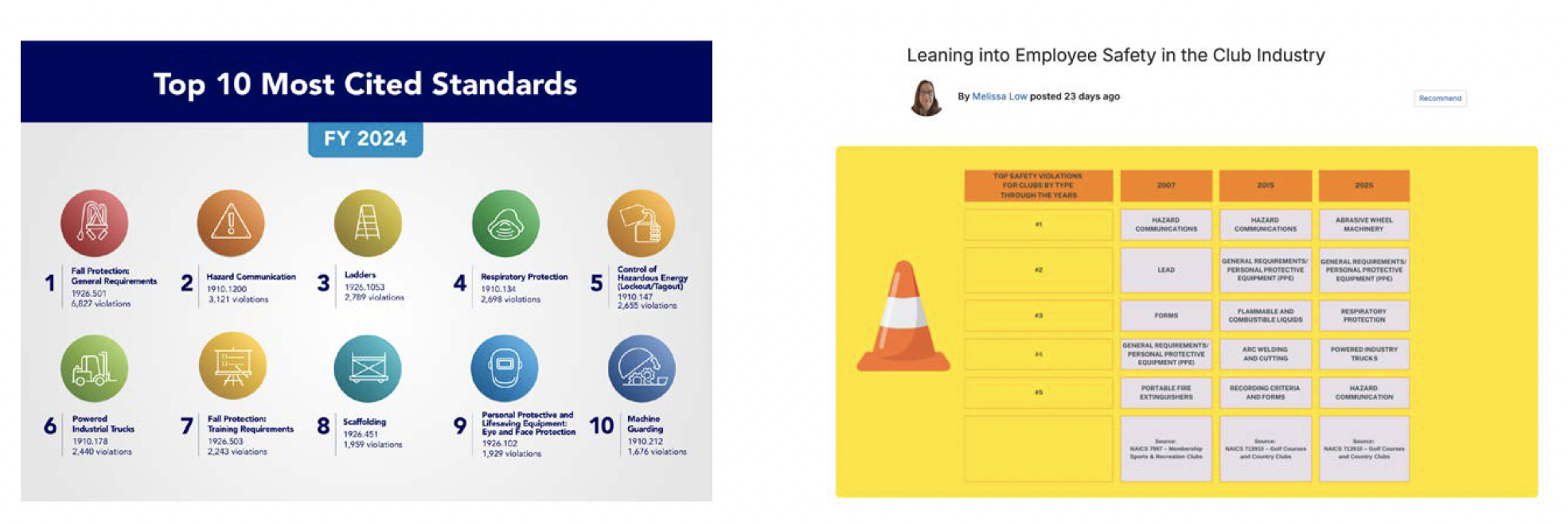
It has been more than 15 years since the conclusion of the Alliance in 2009 but the workplace safety and health issues facing the club industry have not changed significantly. Looking at the available data, clubs are struggling with compliance in the same areas identified by the Alliance in 2003. Hazard Communication, Recordkeeping, and Respiration Protection remain part of the top 10 OSHA violations at clubs.
Further, these instances mirror OSHA’s 2024 Top 10 Most Frequently Cited Standards for general industry.
Key Takeaways for Clubs Today
- Add safety training into your employee’s onboarding process. Whether your onboarding is in-person or virtually, ensure that new employees are fully briefed. Virtual training should be accompanied by in-person demonstration on any assigned machinery or equipment.
- Add safety to the agenda of every staff meeting. By continually educating your employees, you will make safety a priority, thus preventing costly incidents at your club and ensuring the well-being of your employees. Use the sidebar accompanying this article to get started.
- Reassess your club’s safety hazards regularly. What new health and safety concerns do clubs today face? Are there new hazards with the explosion of gym and health & wellness facilities? Is your club renovating? What about new requirements, like the potential for a federal heat safety standard?
Learn more in the Legislative Report Blog

CMAA News & Announcements
Understanding the Competency Areas in Club Management
CMAA’s educational curriculum is based on competency areas covering every aspect of a club management professional’s job and responsibilities. These professional competencies represent the skills and knowledge that are highly valued and required for success in the club management career path.
The competencies were updated in June 2020 and are part of the Business Management Institute curriculum and reflected in the Certified Club Manager (CCM) exam.
Conceptual Skills
- Club Governance: Educates board on best practices; GM performance reviews; Board self-evaluation; strategic planning; club mission and vision; governance succession plan; board and committee orientation; roles and responsibilities; board goals and objectives; club elections and bylaws; promoted fiduciary duty; record retention; GM/COO role; meeting management; forecasts and explains club industry challenges.
- Interpersonal Skills: Transparency; active listener; timely and constructive feedback; tactful; self-aware; builds rapport; effective presenter; speed reads; diffuse conflicts; negotiates effectively; effective communicator; articulate; builds a network.
- Leadership: Personal strategic plan; self-improvement; time management; ethics; critical thinking skills; change management; innovation; industry trends; diversity and respect; coaches; mentorship; delegation; empower others; core values; personal mission and vision; inspiring; motivation; collaborative; philanthropic; empathetic; role model; represents club brand.
Administrative Skills
- Accounting, Finance, and Data Analytics: Understands financial standards; data analytics; annual audit; financial statements; budgeting; capital; data collection systems; forecasting; variance analysis; benchmarking; ratios; lease vs. buy; labor costs and compensation; communicates data; internal controls.
- External Governmental Influences: Compliance; legal concepts and requirements; applies applicable laws; safe and secure working environment; compensation laws; independent contractors; copyright, tax, health and safety laws; tax status; private status; federal forms; data protection and privacy; licensure; zoning; permitting; waterways.
- Human and Professional Resources: Employee policies; employee recruitment, selection, orientation, and onboarding; employee culture; compensation program; employee performance reviews; human resource strategy; succession planning; correction action plans; employer of choice; confidentiality; compliant.
- Membership and Marketing: Member and guest service management program; marketing principles; traditional and digital media; societal trends; publicity; public relations; membership retention and recruitment; societal preferences; situational analysis; marketing research.
Technical Skills
- Facilities Management: Risk management, liability, and safety issues; maintenance; facility assessments; renovations; construction; reserve analysis; building permits; construction contracts; legal responsibilities of contracting parties; capital project communication; trends; plans for maintenance and capital projects.
- Food and Beverage: Food/beverage purchasing, receiving, storing, and inventory control; dining strategies; consistent food and service quality; F&B operating budget; forecast need and track monthly progress; responsible service of alcoholic beverages; food-related allergies; foodborne illnesses; recalls; understand F&B competitors; F&B laws; menu planning.
- Golf, Sports, Recreation, & Wellness: Golf, wellness, sport, recreation, spa, fitness, aquatics, family and youth programming; conduit of trends; retail offerings; amenities are offered, efficiently managed, maintained and operated; facility infrastructure; amenity financial planning and operating budgets; sport emergency protocol; fairness in sport; working knowledge of sport; sport etiquette.
- Information Technology: Integrated technology; technology strategy; technology management; cybersecurity; back up and disaster recovery plans; reservation systems; member data management; software selection; planning for technology

Upcoming Governance & Leadership Symposium on April 15
Make your club’s governance bloom in 2026. CMAA’s next Governance & Leadership Symposium on April 15 offers accessible, collaborative, virtual education for your Board of Directors and club executive. Designed for our West Coast attendees, this program will run from 9:45 a.m. to 4:30 p.m. Pacific Time (PT). Attend from anywhere with an Internet connection. These Symposiums offer actionable insights and tools to strengthen club governance, and you will walk away with a deeper understanding of your role and valuable strategies to improve your leadership contributions. Presented in partnership with KOPPLIN KUEBLER & WALLACE, a CMAA Executive Partner, these highly rated sessions provide a unique opportunity to gain new perspectives and foster stronger partnerships between club management and elected leaders.