
Board Brief
December 2025
Designed for Club Board of Directors

Inside this Issue:
-
Insights: What Do GMs/COOs Need from Great Club Board Members?
After nearly three decades of observing boards in action, one thing is clear: high-performing board members don’t just attend meetings, they drive progress. -
By the Numbers: Impacts of a Strategic Plan
Considering the range of methods used to track progress, mainly when clubs miss an opportunity to track progress toward strategic goals, it is important to understand how this affects the ability to demonstrate the value provided to members. -
Best Practices: Why Every Private Club Needs a Brand Refresh (and How to Do It Right)
Private clubs are built on tradition, legacy, and belonging. Yet even the most respected clubs reach a point where their image no longer matches their reality. -
External Influences: EPA Proposes Update to Waters of the US Rule
On November 20, the US Environmental Protection Agency (EPA) in conjunction with the Army Corps of Engineers (Corps) proposed an update to the rule defining what waters fall under the jurisdiction of the federal government. -
Podcast Spotlight: Navigating Cybersecurity Trends
In this episode, we are thrilled to welcome back to our podcast, our favorite cybersecurity experts at Pulsar Security, a CMAA Education Partner, for answers to our questions about current cybersecurity trends. -
CMAA News & Announcements: Invest in Your Club’s Governance in 2026
Great club governance doesn’t happen by accident—it’s driven by intentional action. It requires deliberate focus and consistent investment from the club executive and the Board of Directors.

Insights
What Do GMs/COOs Need from Great Club Board Members?
After nearly three decades of observing boards in action, one thing is clear: high-performing board members don’t just attend meetings, they drive progress. They’re aligned, strategic, and accountable to the club’s mission and to one another.
General Managers and Chief Operating Officers (GMs/COOs) who have great board members have invaluable partners who understand that their role is strategic governance, not day-to-day management. These leaders come prepared to ask thoughtful questions and keep discussions focused on the right things. They serve as ambassadors for the club, modeling the culture and values expected of the membership while also providing the continuity and perspective needed for long-term stability. Most importantly, great volunteer leaders trust their professional staff to execute initiatives, and they show their support by removing obstacles, offering feedback, and showing appreciation.
Club board members add real value when they elevate conversations beyond personal interests and focus on what’s best for the entire membership. Their ability to think strategically, support management, and steward the club’s mission ensures the board is not just functional but a driving force for progress and sustainability.
Six Ways Volunteer Leaders Add Real Value:
- Drive Membership Culture: Be a visible and constructive influence within the membership. Great board members lead by example, reinforcing civility, inclusion, and the overall member experience through their behavior and communications.
- Support Capital Planning and Funding: Advocate for smart capital investments that align with the club’s long-term needs. Help fellow members appreciate the rationale behind projects and funding mechanisms, ensuring transparency and unity.
- Recruit and Develop Future Board Talent: Build the pipeline. Identify and encourage future board members who reflect the club’s values, understand governance, and bring strategic values, not personal agendas, to the boardroom.
- Think Through Big Decisions Strategically: Offer judgment, not management. Provide thoughtful input and long-range perspective, helping the General Manager and team think through complex issues without getting involved in day-to-day operations.
- Provide Steady Support in Times of Conflict or Failure: The best board members remain calm and supportive during challenges, whether it’s a tough financial moment, a staffing change, or a difficult member issue. Come prepared to be a reliable ally, rather than add distraction, unnecessary conflict, or unwanted drama.
- Model Accountability Through Mission, Vision, Values, and Goals: The best boards operate with alignment and integrity. Every decision should reflect the club’s Mission (purpose), Vision (future), Core Values (standards), and Master Goals (strategy). Board members are also stewards of transparency, communicating the “why” behind decisions, and upholding accountability not only among themselves, but across the broader membership.
After nearly 30 years of working alongside private club boards, we confidently say that great governance is what separates thriving clubs from struggling ones. When volunteer leaders embrace their role and exemplify these traits, they elevate not only the performance of their GMs/COOs and management teams, but they also elevate the entire member experience. The most effective boards embrace where their true value lies. In doing so, they create a sustainable foundation for progress, stability, and long-term club success.
Insights by Richard M. Kopplin, CMAA Fellow, KOPPLIN KUEBLER & WALLACE

By the Numbers
Impacts of a Strategic Plan
The 2025 edition of the Club Leaders’ Perspective Report from CMAA and GGA Partners dives into the importance of utilizing a strategic plan to measure progress. The following is excerpted from the Report:
Considering the range of methods used to track progress, mainly when clubs miss an opportunity to track progress toward strategic goals, it is important to understand how this affects the ability to demonstrate the value provided to members. Figure 4 illustrates this effect by showing the change in tracking financial and non-financial vale creation metrics based on whether a club actively uses its strategic plan to measure success.
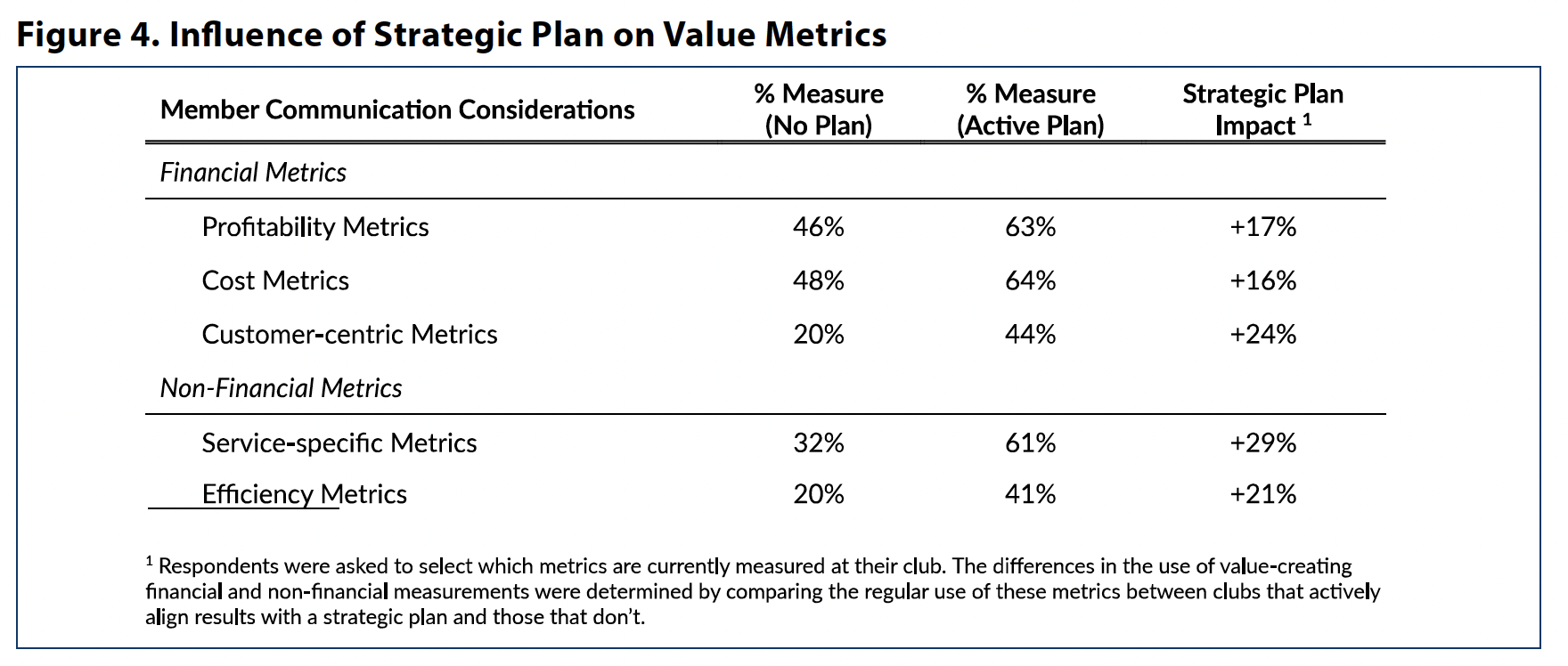
Results show clubs that actively compare results to their strategic plan have significantly more insight into the value they provide members. The collection and calculation of both financial (an average increase of 19 percent) and non-financial data (average increase of 25 percent) were more frequent in clubs with a strategic plan. These results demonstrate that having a strategic plan where outcomes are measured can help ensure a club has actionable insights into the value created for its members.
Effective Club Communication
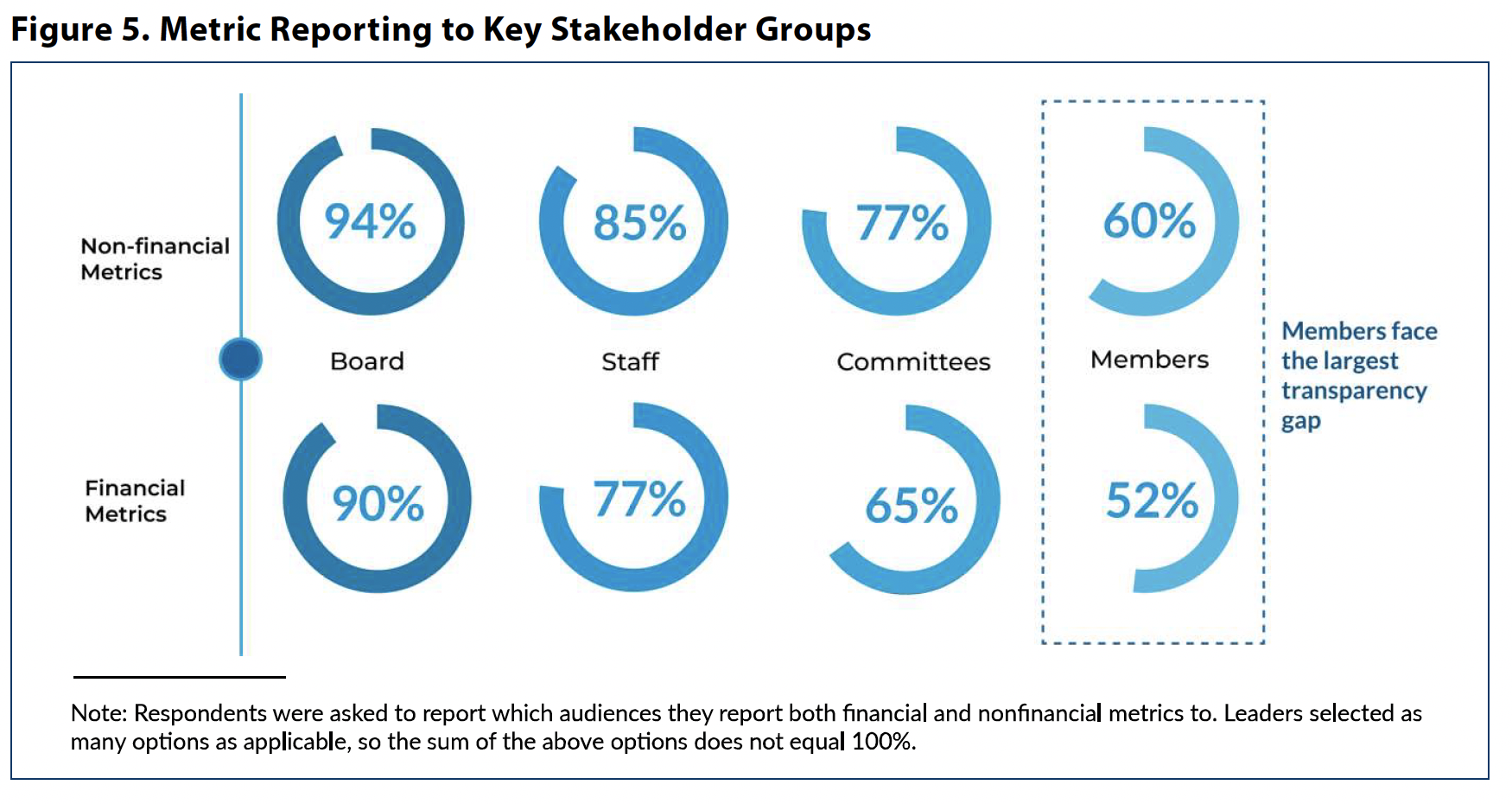
Research indicates that club leaders observe significant variance in data reporting to key stakeholder groups. Figure 5 shows this unevenness, with boards receiving comprehensive reporting while members receive significantly less information. This gap in transparency is evident as only 60 percent of clubs provide members with non-functional updates, and just 52 percent provide financial insights.
Tailoring Communication
Clubs can tailor communication to different stakeholder groups to facilitate a more informed membership. Boards are already well-informed with financial and non-financial metrics, as they should be. Members may benefit from more operational and experiential data, such as improvements in staffing, member satisfaction, and utilization statistics. Effectively reporting these metrics by highlighting tangible components of the experience that most impact member value creation can preemptively address member concerns and bridge perception gaps with information.
Club Leaders Opportunity
Leaders can customize their messaging strategy for various stakeholder groups to improve how a club communicates its value to members. This ensures that members are well-informed about operational and experiential enhancements. Clubs can also focus on the following:
- Prioritize Member Communication on Value: Leaders can enhance engagement and satisfaction by aligning communication strategies with member priorities and elevating transparency. Prioritizing effective communication as a core strategic tenet will build trust and reinforce the value of membership.
- Develop and Connect KPIs to Strategic Priorities: Establish key performance indicators (KPIs) directly linked to the club’s strategic priorities. This ensures that value creation is measured and monitored in the most relevant and critical areas.
- Create a Collection and Reporting Plan: Implement structured methods for collecting data (e.g. surveys, internal financial/non-financial metrics, external benchmarks) and reporting results to members. Define clear standards and targets for success and integrate these efforts into a tailored reporting plan for key stakeholders.
- Adopt a Quality-Over-Quantity Approach: Select benchmarks that provide meaningful context by comparing performance to more outcome-relevant and historical data. Utilize varying benchmarks for factors such as amenity composition, revenue levels, and membership size to ensure the comparisons are as relevant as possible.
Clarifying the connection between operational decisions, such as staffing levels and operational investments, and strategic decisions, including competitive market position and pricing strategy, can justify the strategic investment of club resources. This clarity helps members understand and appreciate these investments, even when they are not immediately evident.
CMAA members may access their complimentary copy of the full report through CMAA Connect in the Best Practices Exchange Community Library in the CMAA Annual Reports folder.
Best Practices
Why Every Private Club Needs a Brand Refresh (and How to Do It Right)
Private clubs are built on tradition, legacy, and belonging. Yet even the most respected clubs reach a point where their image no longer matches their reality. The membership has evolved. The experiences have improved. The story has grown richer. But the brand that represents it all has stayed the same.
We’ve guided dozens of clubs through brand evolution, from century-old institutions steeped in tradition to modern city clubs redefining what membership means today. Through that experience, we’ve learned that the strongest club brands are not the ones that hold tightest to the past, but the ones that honor it while confidently moving forward.
A common misconception we hear is that a brand refresh means starting over. It doesn’t. It means aligning how your club looks and sounds with the level of experience your members already feel. It’s about ensuring the perception of your brand matches the excellence you deliver every day.
How Often Should a Club Revisit Its Brand?
Industry best practices show that brands should refresh every 3 to 5 years and rebrand every 10. This rhythm keeps your story relevant while maintaining the trust and familiarity your members value.
In the club world, those timelines can feel ambitious. Many boards worry that refreshing a logo or updating messaging could erase decades of history. But what actually happens is the opposite. A thoughtful refresh strengthens connection. It brings your heritage forward in a way that resonates with both loyal and prospective members.
Branding Should Reflect Where You Are Going, Not Just Where You Have Been
A refreshed brand might introduce a modern color palette, new photography, or a refined tone of voice. But beneath those updates lies something more important: clarity. It defines what the club stands for now and what it aspires to be in the years ahead.
How to Know It’s Time for a Refresh
Ask yourself:
- Does our brand still represent who we are today?
- Do our visuals and messaging align with the quality of our member experience?
- Are we attracting the next generation of members?
- Do our communications feel consistent across print, digital, and in-person touchpoints?
- Have our spaces, amenities, or leadership evolved while our story has stayed the same?
If any of these ring true, it is time to explore a brand refresh.
The Right Way to Rebrand a Private Club
A successful rebrand begins with understanding. Before changing a single color or font, we take the time to listen to members, staff, and leadership. We uncover what defines your community and what differentiates you in a competitive market. From there, we build a visual and verbal identity that enhances, rather than replaces, the legacy your members love.
A club’s brand is more than design. It is the feeling members get when they walk through the doors, the pride they feel when bringing guests, and the story they tell when describing their experience. When your brand reflects that, it becomes your greatest recruitment and retention tool.
Refreshing your brand ensures your legacy continues to grow, your message connects with the next generation, and your story is told with clarity, confidence, and purpose.
Best Practices by Erica Martin, Director of Marketing and Member Experience, Strategic Club Solutions

External Influences
EPA Proposes Update to Waters of the US Rule
On November 20, the US Environmental Protection Agency (EPA) in conjunction with the Army Corps of Engineers (Corps) proposed an update to the rule defining what waters fall under the jurisdiction of the federal government. This definition has fluctuated since 2015, creating ongoing confusion for clubs and other property owners and the federal permitting process administered by the Corps.
The proposed rule is designed to fully implement the Supreme Court’s 2023 Sackett decision, reduce red tape for property owners, and protect water quality by striking a balance between federal and state oversight.
The EPA and Corps seek to focus federal oversight on relatively permanent, standing, or continuously flowing bodies of water—such as streams, oceans, rivers, and lakes—and wetlands that are connected and indistinguishable from such waterbodies.
Of interest to the club industry, the proposed rule:
- Defines “relatively permanent,” focusing on those waters that are standing or continuously flowing year-round or at least during the “wet season.” This would be applicable to tributaries, lakes, and ponds.
- Defines “tributary” to ensure only those relatively permanent bodies of water that meet specific requirements would be considered jurisdictional.
- Defines “continuous surface connection,” creating a new two-part test for wetlands to be jurisdictional. First, wetlands must adjoin jurisdictional waters. Second, they must contain surface water at least during the wet season.
- Removes interstate waters from the categories of jurisdictional waters, clarifying that such waters would not qualify simply by crossing state lines.
- Clarifies what constitutes “excluded ditches.” The proposed definition distinguishes these features from other types of waters and excludes those ditches constructed or excavated in dry land.
- Excludes groundwater.
Further, the proposed rule creates a new definition, “wet season,” a determination that would vary by location and use the measurement of precipitation. The metric would rely on the methodology used by the WebWIMP, a tool developed ty the University of Delaware.
The release of the rule was significantly delayed by the recent government shut down. The EPA and Corps will be accepting public comment on the proposed rule for 45 days until January 5, 2026. As part of the Waters Advocacy Coalition, CMAA will submit comments on behalf of CMAA members.
Podcast Spotlight
Navigating Cybersecurity Trends
In Episode 148 of Let’s Talk Club Management, we are thrilled to welcome back to our podcast, our favorite cybersecurity experts at Pulsar Security, a CMAA Education Partner, for answers to our questions about current cybersecurity trends. Pulsar is a company whose mission extends to protect clubs and their members against malicious attacks. The company is a Veteran, privately owned business built on vision and trust, whose leadership has extensive military experience enabling it to think strategically and plan beyond the problems at hand. We are excited to welcome back the CEO and Founder of Pulsar Security, Patrick Hynds and Chief Technology Officer Duane Laflotte.

CMAA News & Announcements
Invest in Your Club’s Governance in 2026
Great club governance doesn’t happen by accident—it’s driven by intentional action. It requires deliberate focus and consistent investment from the club executive and the Board of Directors. Your club’s efforts should begin with preparation and education.
CMAA’s Governance & Leadership Symposiums offer accessible, collaborative, virtual education for your Board of Directors and club executive.
2026 Symposiums
- January 7 – 9:45 a.m.-4:30 p.m. ET
- April 15 – 9:45 a.m.-4:30 p.m. PT, Designed for West Coast Attendees!
- July 22 – 9:45 a.m.-4:30 p.m. ET
- November 19 – 9:45 a.m.-4:30 p.m. ET
Attendees highly rate these Symposiums. Your Board Members will leave this symposium more informed and equipped with key takeaways for improving club governance.
These highly rated Summits are presented in partnership with KOPPLIN KUEBLER & WALLACE, a CMAA Executive Partner.
