
Board Brief
February 2026
Designed for Club Board of Directors

Inside this Issue:
-
Insights: How Do You Turn a Racquets Pro Shop into a Profit Shop
When run strategically, your shop strengthens your racquets program, supports your teaching professionals, and enhances member loyalty. -
By the Numbers: Understanding the Purpose of the Operating Ledger
The insights presented here are essential for the effective management and governance of private clubs, particularly those that are member-owned. -
Best Practices: Three Steps Toward Better Governance
Directors of private clubs have four primary responsibilities… durable strategy, sustainable finance, transparent and responsible governance, and trustworthy leadership. -
External Influences: CMAA and Allies Provide Input on the Waters of the US Definition
The definition of what waters fall under the oversight of the federal government, known as the Waters of the United States, has fluctuated since 2015, creating ongoing confusion for clubs and other property owners. -
Podcast Spotlight: Ethics & Club Management
In this episode, we explore ethics and their impact on decision-making in the club industry. -
CMAA News & Announcements: ClubCareers: Find Your Club’s Next Leader
Are you looking for your club’s next leader? List your position with CMAA’s ClubCareers and advertise directly to CMAA members who are seeking new opportunities, both at the executive and mid-management levels.

Insights
How Do You Turn a Racquets Pro Shop into a Profit Shop
A racquets pro shop should be more than a place to buy gear. It should be a high-performing profit center and a core part of your member experience. When run strategically, your shop strengthens your racquets program, supports your teaching professionals, and enhances member loyalty.
Here’s how to elevate your pro shop, on the court and online, to generate consistent, sustainable revenue.
How Can You Make the Pro Shop the Hub of the Member Experience?
A successful shop starts with service, not sales. Members trust your staff and pros for gear advice, so position your shop as an extension of coaching and connection.
Practical steps:
- Stock premium brands members already love (Babolat, Wilson, Head, etc.).
- Carry club-branded apparel to build identity and pride.
- Offer restringing, grip replacement, and racquet customization.
- Educate members through mini gear clinics or “Ask the Pro” sessions.
Pro Tip: Reward teaching professionals with a small commission for every product referral. Their endorsement builds trust and drives conversions naturally.
How Can Events Become Retail Opportunities?
Every league match, tournament, or junior event is a built-in retail moment. Use those gatherings to create buzz and generate sales.
Ideas that work:
- Pop-up displays near courts and check-in tables
- Limited-edition or event-branded apparel
- Demo racquet stations with pro guidance
- Raffles or giveaways tied to purchases
Vendor partnerships are key. Invite reps for trunk shows or sponsor product demo days. Limited-time exclusives add urgency and elevate the experience.
How Do You Extend the Shop Experience Online?
Today’s members expect 24/7 convenience. Creating a seamless online extension of your pro shop helps you sell during off-hours and to traveling members.
- Choose the Right E-Commerce System
Use a POS that syncs inventory with your website, such as Shopify or Square. This keeps pricing and stock accurate in real time. - Keep It Members-Only
Create a password-protected member portal featuring exclusive pricing and early access to new releases. - Showcase Custom Services Online
Allow members to:- Reserve demo racquets
- Schedule stringing or regripping
- Pre-order uniforms or team apparel
- Subscribe for seasonal product drops or gift bundles
- Consider affiliate programs/white-labeled storefront or subsite
- Offer Flexible Fulfillment
Maintain your club’s high-touch service with local pickup, locker delivery, or in-home drop-off options.
How Can Data Drive Smarter Sales?
Use sales data and seasonality to guide purchasing and promotions.
Actionable insights:
- Rotate inventory seasonally: platform tennis in winter, pickleball in spring.
- Reward frequent shoppers with “Pro Shop Bucks” or loyalty points.
- Track bestsellers and create personalized recommendations.
- Identify your top spenders and surprise them with early-access perks.
How Should You Promote the Pro Shop Within the Club?
Visibility drives engagement. Integrate your shop into your club’s broader communications:
- Add features to newsletters and email confirmations (“Gear of the Month,” “Pro Picks”)
- Include pro shop highlights in lesson recaps or clinic reminders
- Run targeted digital ads (consider videos) on your club website, app, or member emails to announce new arrivals or seasonal promotions.
- Share behind-the-scenes photos or unboxing on social media
- Spotlight pros’ favorite racquets or apparel in stories and posts
This turns awareness into action and action into sales.
How Can You Incentivize Staff to Boost Sales?
Your pros and staff are natural ambassadors. Give them ownership of the shop’s success.
Ways to engage:
- Offer sales bonuses or recognition for high-performing staff.
- Integrate demos into lessons, let players test racquets on court.
- Bundle lessons and gear discounts (e.g., “Buy a series of lessons, get 10% off your next racquet”).
These small touches turn instruction into inspiration and sales.
Blending Service and Strategy
By merging expert, in-person service with online accessibility and data-informed decisions, clubs can transform their shop into a vibrant profit center. Don’t let your shop sit idle between visits. Bring it to life on the court, in the club, and online.
Need Help Setting Up Your Club’s Online Pro Shop?
Racquet Resources, powered by Strategic Club Solutions, helps clubs develop retail strategies that merge tradition with technology. From e-commerce integration to staff training and merchandising, our racquets consulting team can help you maximize your club’s retail potential.
Insights by James McDonald, Strategic Club Solutions

By the Numbers
Understanding the Purpose of the Operating Ledger
From July 2024-June 2025, CMAA and Club Benchmarking collected data from more than 1,200 clubs for the 2024 Club Finance and Operations Survey. In this edition of Board Brief, we will dive into understanding a club’s operating ledger
The insights presented here are essential for the effective management and governance of private clubs, particularly those that are member-owned. Many of the concepts were first introduced by Club Benchmarking in 2015. This section addresses the following foundational topics, each critical to strategic financial management:
- Understanding Purpose of the Operating Ledger
- How Clubs Budget for Operations
- Shifting the Mindset: From Consumer to Stewardship
Understanding the Purpose of the Operating Ledger
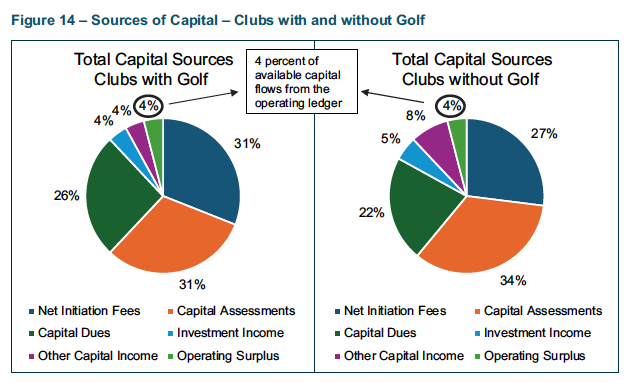
The role of the operating ledger becomes clear when reviewing Figures 12 (clubs with golf), 13 (clubs without golf), and 14. These figures reveal that approximately 75 percent of golf clubs and 70 percent of non-golf clubs operate with a margin of 4 percent or less. In practical terms, this means that for most clubs, the operating ledger does not generate a significant financial return, highlighting that its primary purpose is not profit generation.


How Clubs Budget for Operations
Most clubs begin their budgeting process by forecasting operating expenses. They then estimate non-dues revenue (primarily from food & beverage and other departmental activities) and its associated margins. This helps determine the amount of dues revenue required to reach a breakeven point.
- Some clubs aim to break even.
- Others plan for a small deficit.
- About 25 percent of clubs intentionally budget for a surplus exceeding 4 percent, using the
- operating ledger to generate funds for capital investment.
These surplus-generating clubs are shown in Figures 12 and 13. However, as illustrated in Figure 14, even these surpluses have minimal impact on overall net available capital across the industry.
Operating Funds: Designed to Be Spent
Operating funds are inherently consumable. They cover ongoing expenses such as:
- Payroll
- Cost of goods sold
- Supplies
- Services
- Fixed charges
These funds are used continuously to support the club’s daily operations and member experience. Members contribute through dues and ancillary charges, primarily from F&B, ensuring the club has the resources to deliver high-quality services and amenities.
The more robust a club’s operating revenue, the greater its ability to provide a rich and engaging member experience.
Shifting the Mindset: From Consumer to Stewardship
A common misconception among long-standing members is the belief that, because they have paid dues for many years, the club now “owes them something.” This consumer mindset can be detrimental, leading to underinvestment and deferred maintenance.
Each year represents a fair exchange: members pay dues and fees in return for a high quality experience, ideally one that exceeds the offerings of public facilities.
Educating volunteer leaders and the broader membership is essential. The operating ledger exists to support the member experience, not to generate profit. A healthy financial mindset, whether in finance committee meetings or casual conversations in the grill room, recognizes that more operating funds mean a better experience, especially for the next generation of members, including millennials.

Best Practices
Three Steps Toward Better Governance
Directors of private clubs have four primary responsibilities… durable strategy, sustainable finance, transparent and responsible governance, and trustworthy leadership. Most club boards require steady reminders of these responsibilities while friends and fellow members inundate them with complaints about food and beverage services or tee-time access, or capital-project planning. Club managers play a vital role in helping to keep their board and board members focused the four corners of their responsibility.
Club management professionals can provide boardroom support in three ways:
- Organize board meeting agendas with diligence and achievable time planning.
- Pre-plan each board agenda. Attend to the following keys:
- Welcome and Call to Order
- Approval of Previous Minutes
- Management and Committee Reports
- Strategic Plan Review/Update
- Old Business
- New Business
- Closing or Adjournment
- Preview the upcoming agenda with each board member. Enable board members, however supportive or difficult they may be, to learn from them their viewpoints, concerns, and expectations on each topic. Also, discuss with each of them what your needs are within each agenda item and topic. This 15-minute conversation will prove valuable for you.
Taking this step makes the meeting more efficient in the following ways:
- Alerts you and your board chair to any pending difficulties that may arise.
- Provides a “straw-poll” understanding of board viewpoints.
- Helps to build trust between you and your board members.
- Enables you to allocate time effectively.
Most club managers take board meetings very seriously and seek to provide support in every way that they can do so. Three keys to serving your board well are to:
-
Bring solutions, not problems. Behind club managers’ backs, one of the most common criticisms of the sitting manager is, “This person is our CEO/COO, they are expected to run this business for us. Do you think that CEO at General Electric goes to the board meeting to ask for ideas or permission?” Do not ask for advice or opinions. Discuss what you plan to do and how doing so will benefit the club and its members.
- Demonstrate current knowledge and command of the club’s financials. Private clubs, while non-profit in most cases, are multi-million-dollar businesses for which you and your board members are responsible. Show that you know your business.
To enable your board to make data-driven decisions, provide data in advance of the board meeting with your evaluation of the data and how the data should be used. Beware that the club management field is awash in data currently and not all who are interpreting data understand your field.
Three keys for reporting and using data are:
- Use only current data. Do not rely on lagging information.
- See through complexity to keep board discussions focused on key decisions before the board.
- Provide the full picture of financial and market-related information.
- Keep board meetings time efficient and on task. Using a consent agenda to minimize reporting time for management and committee reports is essential.
Better governance is the routine achievement of many small tasks well executed.
Best Practices by Henry DeLozier, Partner, GGA Partners

External Influences
CMAA and Allies Provide Input on the Waters of the US Definition
The definition of what waters fall under the oversight of the federal government, known as the Waters of the United States, has fluctuated since 2015, creating ongoing confusion for clubs and other property owners and the federal permitting process administered by the Army Corps of Engineers (Corps). On November 20, 2025, the US Environmental Protection Agency (EPA) in conjunction with the Corps proposed the latest update to the rule.
The EPA and Corps seek to focus federal oversight on relatively permanent, standing, or continuously flowing bodies of water—such as streams, oceans, rivers, and lakes—and wetlands that are connected and indistinguishable from such waterbodies. The proposed rule creates a new definition known as a “wet season,” a determination that would vary by location and measures climatically averaged, monthly water balance by considering the air temperature and precipitation.
The EPA and Corps requested public input on the proposal, and public comments were accepted for 60 days. On January 5, CMAA joined the effort led by the Golf Course Superintendents Association of America in collaboration with the National Golf Course Owners Association, the National Club Association, the American Society of Golf Course Architects, and the Golf Course Builders Association of America.
In the comments, the industry shared its collective perspective and requested further collaboration on the definition of the “wet season” identified as a measure of “relatively permanent” bodies of surface water. The comments explained that “golf course superintendents surveyed were not familiar with the Web-based Water-Budget Interactive Modeling Program (WebWIMP) and more education and training and implementation practice would need to be provided by the Agencies if this were to be one of the tools they could use to help them determine the wet season.” Additionally, the comments explained that “land managers must understand which water bodies are covered without requiring volumes of data collection, the execution of complicated models and expensive consultation with subject matter experts.”
Additionally, CMAA participated in additional technical comments through the Waters Advocacy Coalition.
The EPA and Army will review all submitted comments and continue the rulemaking process. The final rule and implementation are expected later this year.
Podcast Spotlight
Ethics & Club Management
In this episode of Let’s Talk Club Management, we explore ethics and their impact on decision-making in the club industry. Researchers from Michigan State University have been exploring this topic for 35 years. The research was first undertaken in 1989, revisited in 2010, and again in 2024. In this research, club executives were asked to measure their responses to 15 ethical scenarios.
We’re joined by Jeffrey A. Beck, Ph.D.; Raymond S. Schmidgall, Ph.D., CPA; and Richard A. Bruner CCM, CCE, with The School of Hospitality Business at Michigan State University to discuss this interesting research.

CMAA News & Announcements
ClubCareers: Find Your Club’s Next Leader
Are you looking for your club’s next leader? List your position with CMAA’s ClubCareers and advertise directly to CMAA members who are seeking new opportunities, both at the executive and mid-management levels.
If you are seeking executive management personnel, CMAA’s Managerial Openings List (MOL will connect you with club management professionals seeking roles as General Managers, Chief Operating Officers, and Directors of Operations, and more. All postings on this list have salary ranges at $100,000 or above.
If your club is seeking mid-management personnel, CMAA’s Mid-Management Openings List (MMCO) will connect you with club management professionals seeking roles Clubhouse Managers, Food and Beverage Managers, Banquet Managers, among others. All postings on this list have salary ranges under $100,000.
Additional resources are available including sample job descriptions and the Interim Management List, an online listing of CMAA members who are available to fulfill various interim management positions.
Since the inception of ClubCareers in 2003, the site has hosted thousands of jobs.