
Board Brief
March 2026
Designed for Club Board of Directors

Inside this Issue:
-
Insights: Keeping the Right People on the Bus
The “who” of your team opens tremendous possibility for you and your teammates. Keep them. -
By the Numbers: Understanding the Role of Food & Beverage in the Operating Ledger
A persistent challenge in club financial management is the debate over whether Food & Beverage (F&B) should be treated as an amenity or a profit center. -
Best Practices: Eliminate the Popularity and Name Recognition Contest in Board Elections
Much has been written about Nominating Committees and best practices, but how does one do it on a granular level for an HOA/POA or Club? -
External Influences: New Proposed Independent Contractor Rule Announced
In the proposed rule, the DOL would officially rescind the 2024 rule and reinstate a modified version of the 2021 Independent Contractor rule. -
Podcast Spotlight: Mentoring and Development
In this episode, we learn from 2025 Club Executive of the Year, Randy Ruder, CCM, CCE, CMAA Fellow. -
CMAA News & Announcements: Understanding the Value of the Certified Club Manager (CCM) Designation
First launched in 1965 and developed by educators and club industry professionals, the Certified Club Manager (CCM) designation is acknowledged worldwide as the symbol of excellence in club management. -
CMAA News & Announcements: Upcoming Governance & Leadership Symposium on April 15
Designed for our West Coast attendees, this program will run from 9:45 a.m. to 4:30 p.m. Pacific Time (PT). Attend from anywhere with an Internet connection.

Insights
Keeping the Right People on the Bus
In his best-selling 2001 book, Good to Great: Why Some Companies Make the Leap and Others Don’t, Jim Collins advised “get the right people on the bus” and a key for managers in 2026 is to keep the right people on the bus. The “who” of your team opens tremendous possibility for you and your teammates. Keep them.
Retention and how to optimize it will be a primary need as most private clubs settle into a post-pandemic mode of operation. In today’s world, three points of focus are required for reliable retention planning:
Co-Create Career Development Plans for Each Key Person on the Bus
Elemental to keeping your best teammates is working with them to develop a career-growth plan for themselves while working with you. Remember to:
Ask what they find most—and least—interesting in their work. Create a constructive blend of each part to make their career-growth challenging and rewarding.
Make the planning process collaborative. This is the employee’s career plan and not your own so emphasize this important distinction.
Faithfully follow-through with performance reviews and evaluations.
Provide Challenging and Stretching Assignments
Your best people want to be challenged. Top performers embrace difficulty and succeed. Refer to your performance evaluations and maintain aligned continuity of identifying performance aspects that need improvement and devise training that causes improvement for them.
Watch for individual skillsets and internal opportunities for your teammates to expand their career reach and footprint. Show culinary professionals how their attention to detail prepares them to advance their careers into general management if they are interested. Show your athletic (golf, tennis, fitness) professionals how their openness and friendliness can enable them to increase their range of skills that might enable them to earn greater wages or to redirect their management careers.
Show That You Care for Them
Establish and adhere to a mutually agreed upon review schedule and adhere to it. Beyond your own knowledge, only your commitment to them is of greater value. You can demonstrate your commitment to your top performers by sharing with them your time and insight.
As a part of your personal commitment to your key people, learn about them, their hopes, dreams, and fears. Learn about their families and what motivates them. Be alert to signals, whether verbal or performance related, that suggest fatigue, discouragement, or disinterest.
Retention will be a primary strategic need for most private clubs throughout 2026. Many club members miss the point that your staff members have career aspirations and benefit from thoughtful planning and encouragement. Every manager worth his or her salt knows that recruiting top people is mission-critical in these times…keeping them is even more urgent.
Collins’ research team showed that the people on your team/bus attract others like them. So, whether your direct reports are A+ people or not, they attract others like themselves. Your best recruiters of new talent are already on your staff if you enable and empower them.
Insights by Henry DeLozier, Partner, GGA Partners

By the Numbers
Understanding the Role of Food & Beverage in the Operating Ledger
From July 2024-June 2025, CMAA and Club Benchmarking collected data from more than 1,200 clubs for the 2024 Club Finance and Operations Survey. In this edition of Board Brief, we will dive into understanding the role food & beverage plays in a club’s operating ledger.
The insights presented here are essential for the effective management and governance of private clubs, particularly those that are member-owned. Many of the concepts were first introduced by Club Benchmarking in 2015. This section addresses the following foundational topics, each critical to strategic financial management:
- Understanding the Role of Food & Beverage in the Operating Ledger
- Initiation Fees and F&B Performance
Understanding the Role of Food & Beverage in the Operating Ledger
A persistent challenge in club financial management is the debate over whether Food & Beverage (F&B) should be treated as an amenity or a profit center. This confusion often stems from a lack of clarity around the core purpose of the operating ledger, which is to fund the delivery of the member experience. Once this purpose is fully understood, the role of F&B and other operating budget components becomes much clearer.
Currently, 91 percent of clubs operate their F&B programs at a loss, a three percent increase from the previous year. The remaining nine percent either break even or generate a surplus. Among those generating a surplus, half report an operating margin of four percent or less, indicating that even these clubs view the operating ledger primarily as a tool to support the member experience, not as a source of profit. In such cases, F&B operations effectively subsidize member dues, reinforcing the idea that the operating ledger is not intended to serve as a financial engine.
Initiation Fees and F&B Performance
Initiation fees serve as a market-based measure of a club’s member experience, reflecting the balance between supply and demand for membership. Clubs with long waitlists and low turnover typically command higher initiation fees, while those with readily available memberships tend to have lower fees.
This relationship is evident in the data:
Clubs with Golf
Median initiation fee for clubs with an F&B surplus: $16,500
Median initiation fee for clubs with an F&B deficit: $60,000
This gap, more than three times, is slightly larger than last year.
Clubs without Golf
Median initiation fee for clubs with an F&B surplus: $7,500
Median initiation fee for clubs with an F&B deficit: $15,000
These figures suggest that clubs investing more in the member experience, often reflected in F&B deficits, are rewarded with higher market valuation through initiation fees. The initiation fee provides a quantitative snapshot of how the market values the club’s member experience.

Best Practices
Eliminate the Popularity and Name Recognition Contest in Board Elections
Much has been written about Nominating Committees and best practices, but how does one do it on a granular level for an HOA/POA or Club? Here is a fresh take on substance. How do you reach qualified candidates who reflect the Mission and Vision of the community, to ensure the agenda-driven candidate is eliminated and the no-nonsense, positive candidate steps up?
Step One: Start Early
Outlining steps for proactive candidate recruitment is your first step toward making the process transparent.
Begin well in advance of the expired terms and host a series of open town hall meetings at different times and on different days to accommodate all members/residents’ availability.
These meetings (different than an annual meeting) should highlight the positive outcome and progress of the past. Discuss future priorities and future challenges. Have a welcome and state the purpose. Have key personnel attend and provide an overview, have the auditor speak to the positives, and your legal representative speak to their role.
Step Two: Introduce Board Service
Have a comprehensive overview of what Board service requires and how the operations team works in concert with the Board’s strategic initiatives. How do the Committees work, and how much time commitment is needed? When and where meetings are held. Are we meeting in person, or is a virtual meeting allowed? Explain what Board service truly entails. In essence, how things get done removes the mystery.
Mention that there is a Code of Conduct signed at the beginning of their terms, which they are to uphold.
Step Three: Past Leadership Involvement
Engage past leadership for their insight to strengthen the future. They can assist in identifying potential candidates and help identify skill sets. Encourage qualified candidates whom they may know. Their perspective and knowledge can help define desired competencies for candidates.
Step Four: Fair and Transparent Nominating Committee
The Nominating Committee should be credible and reputable and have a formal charter. The committee must be beyond reproach and confidential, and it must develop fair evaluation criteria and a scoring method using an independent rating system.
Step Five: Standardized Evaluation Process
The actual evaluation process: all candidates receive the same standardized questions. Focus on governance, finance, and fiduciary understanding. How do they collaborate on decision-making for all? What is their commitment to community-wide priorities? How do they envision working with committees and operational personnel? Do private individual scoring with an independent tally.
Step Six: Candidates Spotlight
Notify the candidates in writing and follow up with a phone call. Record each candidate for a maximum of five minutes and have them outline their reasons for running and highlight their credentials. Post on the website and have a meet-the-candidates function. At the function, include a welcome by the Nominating Chair with separate areas to meet all candidates for an informal two-hour period. Serve refreshments and hors d’oeuvres.
Step Seven: Outsourcing the Voting Process
Have an independent voting company send, tally, and announce the winning results. The result is a much more positive, informative, and engaging process that members/residents understand and feel comfortable stepping forward to improve the entire community.
Best Practices by Terra S.H. Waldron, CCM, CCE, CMAA Fellow, Desert Mountain Club

External Influences
New Proposed Independent Contractor Rule Announced
The Department of Labor (DOL) has proposed a new rule governing how to classify individuals as employees or independent contractors. This rule will replace the 2024 rule that created a six-factor economic realities test to assess the working relationship between the individual and the entity. The 2024 IC Rule took effect on March 11 of that same year. However, the 2024 rule has been hotly contested through multiple legal challenges.
Last May the DOL announced its intent to rescind the 2024 IC rule at the same time it issued interim guidance stating that it would pause enforcement of the 2024 rule. Enforcement of the 2024 rule has been on hold since May 1, 2025.
The Proposed Rule
In the proposed rule, the DOL would officially rescind the 2024 rule and reinstate a modified version of the 2021 Independent Contractor rule. It would also expand the applicability of this definition for the Family and Medical Leave Act (FMLA) and Migrant and Seasonal Agricultural Worker Protection Act (MSPA).
Returning to the structure of the 2021 rule, the determination will be based on two primary factors:
- nature and degree of control over work
- the individual’s opportunity for profit or loss
The 2021 rule focuses on “economic reality,” specifically whether “the individual is economically dependent on that employer for work, as distinguished from an independent contractor, who is in business for him- or herself.” The proposed modifications would examine the nature and character of economic dependence and explore it in the context of work and not solely income.
Three additional factors will provide further information:
- the amount of skill required for the work
- the degree of permanence of the relationship
- whether the work is part of an integrated unit of production
However, these three factors will likely not outweigh the evidence provided in the first two core factors.
Additionally, the determination must focus on actual practice of the relationship vs. what is theoretically possible.
Next Steps
Public comments will be accepted through regulations.gov until April 28.
Podcast Spotlight
Mentoring and Development
In this episode of Let’s Talk Club Management, we learn from 2025 Club Executive of the Year, Randy Ruder, CCM, CCE, CMAA Fellow. In November, Club Management magazine named Randy the 2025 Club Executive of the Year. He currently serves as the General Manager/Chief Operating Officer of Beach Point Club in Mamaroneck, NY. In this episode we get to know Randy a bit better through the eyes of three of his mentees from across his career. We’re joined by Qian Yang, CCM, Batu Catalkaya, and Sam Lipp to hear more about Randy’s impact and influence on their career paths.

CMAA News & Announcements
Understanding the Value of the Certified Club Manager (CCM) Designation
First launched in 1965 and developed by educators and club industry professionals, the Certified Club Manager (CCM) designation is acknowledged worldwide as the symbol of excellence in club management. The CCM is awarded only to those club management professionals who complete a combination of industry-specific education and pass a rigorous examination. The CCM recognizes skills and special knowledge in areas such as club governance, leadership, and financial management. Once the designation is earned, the CCM must maintain their level of knowledge with ongoing education.
Another benefactor of the CCM program is the club as an employer. Certification can be valuable for an employer’s reputation. Employees who have earned the designation through industry specific training, work experience, and assessment have demonstrated a level of competence that can affect the perception among the club membership.
Other benefits to hiring a CCM include:
- Validating the competency of the club manager. Having a CCM on staff may ensure that your employee possesses current, relevant skills that afford them deeper insight into the industry, and a higher level of overall competence. With knowledge of recent trends, the latest regulations, and new and developing options, your CCM will become the “go to” person in directing the club.
- Promoting staff retention. By providing employees with opportunities to grow their talents and master new skills through the CCM program, you are demonstrating a commitment to their professional development that can translate into greater company loyalty.
- Assisting with managing risk. The CCM exam addresses applicable laws and regulations related to industry. Employees with knowledge of these laws and regulations can assist with steering your club through potential problems, make recommendations that may prevent complications, and provide the club governance with advice.
The CCM is a globally recognized designation for club management professionals and the standard by which individuals demonstrate their professionalism in club management. Approximately 1,500 CMAA members hold this prestigious designation. Earning the CCM is a valuable achievement and a professional advantage for club management professionals at any stage of their career.

CMAA News & Announcements
Upcoming Governance & Leadership Symposium on April 15
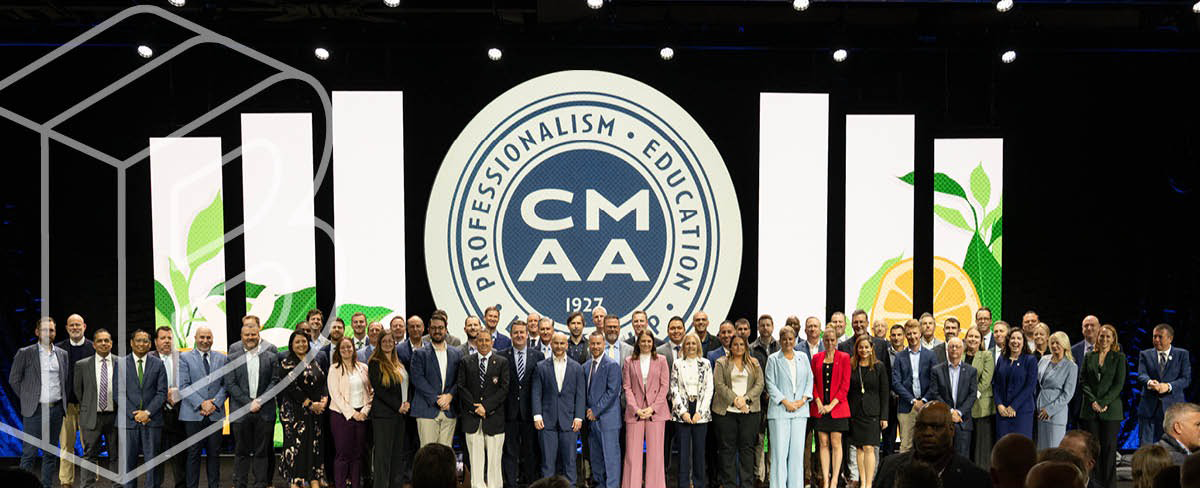
Make your club’s governance bloom in 2026. CMAA’s next Governance & Leadership Symposium on April 15 offers accessible, collaborative, virtual education for your Board of Directors and club executive. Designed for our West Coast attendees, this program will run from 9:45 a.m. to 4:30 p.m. Pacific Time (PT). Attend from anywhere with an Internet connection. These Symposiums offer actionable insights and tools to strengthen club governance, and you will walk away with a deeper understanding of your role and valuable strategies to improve your leadership contributions. Presented in partnership with KOPPLIN KUEBLER & WALLACE, a CMAA Executive Partner, these highly rated sessions provide a unique opportunity to gain new perspectives and foster stronger partnerships between club management and elected leaders.