
Board Brief
June 2026
Designed for Club Board of Directors

Inside this Issue:
-
Insights: Is Your Governance Structure Built for Continuity or Vulnerability?
Governance erosion rarely announces itself. Meetings run. Committees report. Elections occur. Most boards believe their structure is sound. -
By the Numbers: The Purpose of the Capital Ledger and Balance Sheet KPIs
A club’s net worth is a critical indicator of its long-term financial health. -
Best Practices: Reimagining Your Summer Seasonal Racquets Program: Part Two
Summer racquets programs at seasonal clubs often fall into predictable patterns. -
External & Governmental Influences: Department of Labor Updates on Overtime and Proposed Independent Contractor Regulations
The Department of Labor rescinded the 2024 overtime rule, officially erasing a proposal that would have significantly increased salary thresholds and created a triennial automatic update for the threshold. -
CMAA News & Announcements: Dynamic Fourth Edition of Contemporary Club Management Now Available
It is the definitive, comprehensive resource on private club operations, covering leadership, food and beverage, golf operations, and finance. -
CMAA News & Announcements: Upcoming Governance & Leadership Symposium on July 22
This event offers accessible, collaborative, virtual education for club Board of Directors and club executives.

Insights
Is Your Governance Structure Built for Continuity or Vulnerability?
Governance erosion rarely announces itself. Meetings run. Committees report. Elections occur. Most boards believe their structure is sound.
Yet during live polling at DENEHY Club Thinking Partners’ CMAA World Conference session in February 2026, Governance Tune-Up: Assessing Outdated Governance Models and Restructuring Processes, the data revealed a different story. Across more than 120 responding clubs, structural gaps surfaced in areas that directly impact continuity, clarity, and fiduciary oversight.
Boards are working hard. The problem is not commitment. The problem is that the governance structure often does not support the board’s objectives.
Here’s what club leaders told us:
Key Findings from 120+ Club Leaders:
- 60 percent lack a documented succession plan for future officers
- 75 percent either lack a Board Policy Manual or have one that is outdated
- 61 percent acknowledge board or committee operational interference
- 35 percent provide no structured orientation for new directors
- 21 percent have bylaws that haven’t been reviewed in 7+ years
Are You Structured for Officer Continuity?
When asked whether their board has a documented succession plan for future officers, 60 percent of participants answered no.
That number should give every board and general manager pause. Without a written succession structure:
- Leadership progression becomes informal
- Institutional knowledge depends on individuals
- Officer readiness varies year to year
- Strategic initiatives stall during transition
- The best volunteer leaders will deploy their volunteer time elsewhere
Succession planning is not about predicting who will serve. It is about defining how leadership evolves.
Boards should consider:
- Is officer progression defined in policy?
- Are expectations for President, Vice President, and Treasurer documented?
- Does your Nominating Committee operate under written authority?
- Can a new director clearly see the pathway to leadership?
Continuity should not rely on tradition alone. It should rely on structure.
Do Your Governance Documents Guide Behavior or Sit on a Shelf?
Polling revealed that only 25 percent of respondents reported having a current and actively used Board Policy Manual. An additional 31 percent said a manual exists but is outdated or inconsistently applied.
Most striking, 40 percent reported having no consolidated Board Policy Manual at all. In many clubs, it exists more in theory than in practice.
That means 40 percent of clubs have no Board Policy Manual at all, and another 31 percent have one that is outdated or inconsistently applied, leaving only 25 percent with a current, actively used framework.
When governing documents are fragmented or stale authority becomes interpretive, committees define their own scope, board–management boundaries blur, and conflict resolution becomes personality-driven
Boards should ask:
- When was the last full governance document review?
- Are Board policies separate from management procedures?
- Do committee charters clearly define authority and limits?
- Are governance documents used during board orientation?
Documentation alone does not create governance strength. Active use does.
Is Your Board Governing or Drifting into Operations?
When asked whether committees or boards micromanage operations, 33 percent said “somewhat” and 28 percent said “considerably”
That means 61 percent acknowledge operational interference at some level.
Additionally, only 52 percent reported that governance documents clearly differentiate between Board Committees and Operations Committees. The remaining respondents described informal or unclear differentiation.
Role confusion rarely starts as a crisis. It starts with small boundary shifts:
- Operational questions consume board meetings
- Committees bypass management channels
- Directors re-engage in tactical decisions
Over time, this produces: GM turnover, staff confusion, strategic drift, and Director fatigue. Boards should reflect:
- Does the board operate at the strategic level?
- Is authority formally delegated to the General Manager?
- Are committee roles documented and enforced?
- Is there a written Delegation of Authority policy?
Boards are charged with strategy and oversight. When they move into operations, accountability blurs. When boards descend into operations, oversight weakens.
What Happens When Directors Turn Over?
Leadership turnover is predictable. Governance instability can be too.
While 65 percent of respondents in the seminar indicated they provide new director orientation, 35 percent reported having no structured onboarding or refresher process.
That gap has consequences. Without formal onboarding, fiduciary duties are unevenly understood, expectations shift with personalities, strategic context gets lost, and repeated “reset” cycles occur.
Boards should consider:
- Is fiduciary responsibility reviewed annually?
- Is there a structured orientation program?
- Does the board maintain a governance calendar?
- Are major decisions documented for future reference?
Institutional memory should not depend solely on the General Manager. It should be embedded in governance systems.
Are Your Bylaws Keeping Pace?
Governance strength begins with foundational documents.
While 62 percent reported reviewing bylaws within the past three years, 21 percent acknowledged their bylaws have not been reviewed in seven or more years.
In a regulatory and operational environment that evolves rapidly, that lag introduces risk.
Outdated bylaws often produce committee structures misaligned with practice nomination processes that lack clarity, voting procedures vulnerable to challenge, ambiguity during contested elections, and legal matters.
A periodic governance review ensures that bylaws reflect how the club actually operates, not how it once operated.
Governance Review as Fiduciary Discipline
A governance review is not corrective. It is preventive. Boards do not review governance because something is broken. They review it because stewardship demands it.
It should clarify officer succession, committee authority, board–management boundaries, and policy consistency. It protects institutional continuity, strategic momentum, leadership stability, and fiduciary credibility
Modernization does not require complexity. Often it requires simplification:
- Clearer charters
- Defined delegation
- Updated policies
- Formal onboarding
- Structured succession
Strong governance is rarely visible during calm periods. Its value emerges during leadership transitions, financial decisions, or political pressure.
The Stewardship Question
The CMAA session polling data revealed something important: many clubs are functioning, but not fully structured.
Functioning governance keeps the club moving. Structured governance keeps it protected.
As your board approaches its next officer transition, strategic initiative, or bylaw review, consider: Is your governance model built to absorb change—or vulnerable to it? Stewardship requires more than good intentions. It requires clarity that outlives personalities.
That is the work of governance.
Insights by Dan Denehy, CCM, CHA, President, and Bob James, CCM, CCE, Vice President, DENEHY Club Thinking Partners

By the Numbers
The Purpose of the Capital Ledger and Balance Sheet KPIs
From July 2024-June 2025, CMAA and Club Benchmarking collected data from more than 1,200 clubs for the 2024 Club Finance and Operations Survey. In this edition of Board Brief, we will continue to dive into understanding the purpose of the capital ledger and balance sheet KPIs.
Net Worth, Asset Health, and Strategic Capital Planning
A club’s net worth is a critical indicator of its long-term financial health. A declining Net Worth signals that the club is consuming its assets faster than it can replace them. Over time, this leads to a decrease in the Net-to-Gross Property, Plant & Equipment (PP&E) ratio, reflecting deteriorating asset conditions. If this trend continues unchecked, the club risks complete asset deterioration, a hallmark of failed clubs. When members recognize that capital reinvestment is no longer viable, they may opt to sell the club.
Even when Net Worth remains flat, club’s assets lose value due to inflation, resulting in a gradual decline in asset quality and sustainability. In contrast, a steady increase in Net Worth enables clubs to replace aging assets and invest in new, aspirational amenities that align with evolving member expectations.
The Importance of Net Worth Size and Growth Rate
It is not just the compound annual growth rate of Net Worth that matters; its absolute size is equally important.
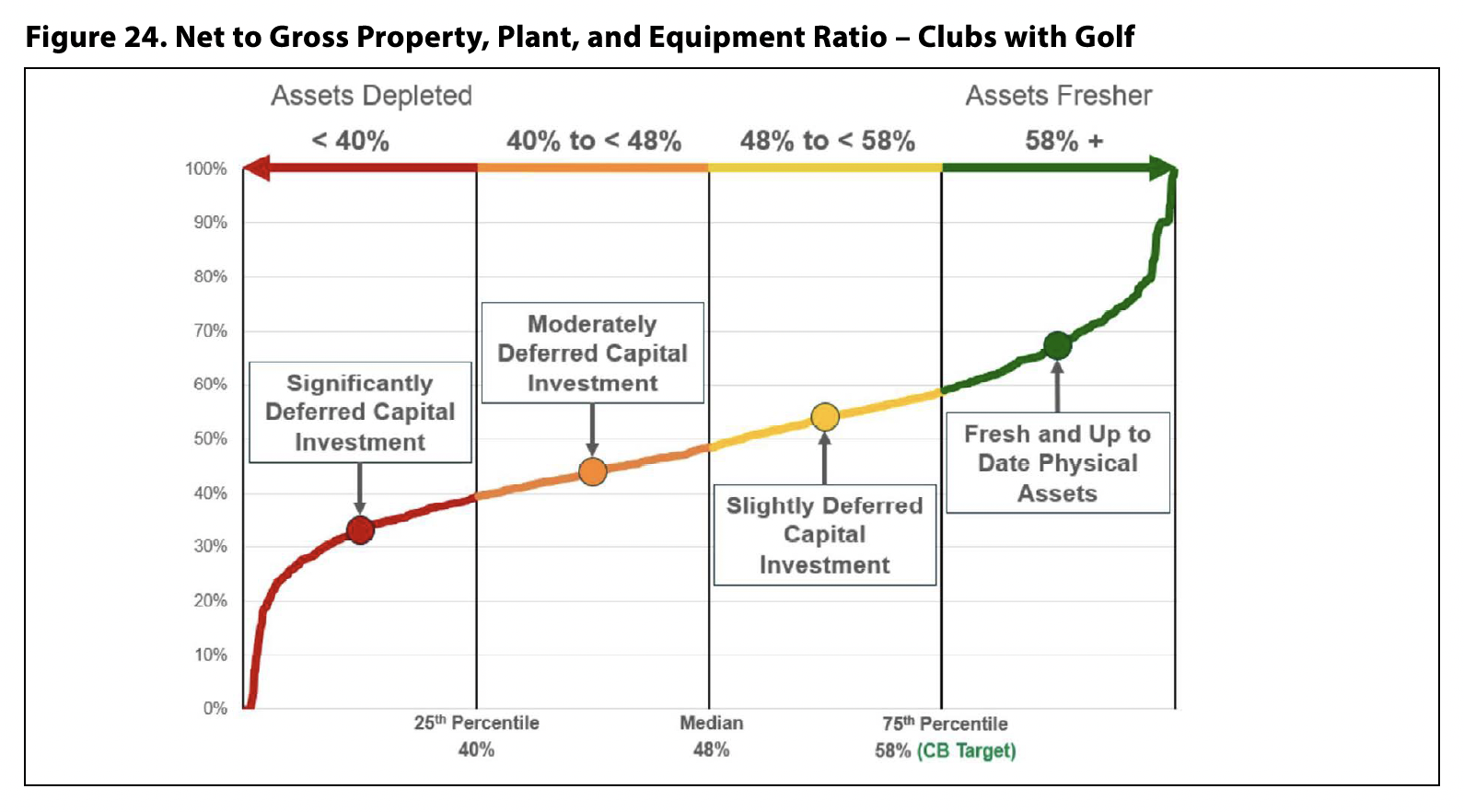
- For instance, consider the amount of money it would take to build a new 18-hole country club in today’s dollars: a clubhouse, a course maintenance facility, all the course maintenance equipment, the golf course and all its infrastructure (cart paths, irrigation systems, pump houses and pumps, etc.), the kitchen equipment, the fitness and wellness, the pool, etc. As shown in Figure 24, the lower quartile of clubs with golf has Net PP&E of $5.28 million (calculated as $13,357,000 Gross PP&E x 0.395 Net-to-Gross Ratio). The Gross PP&E accounts for the book value of all your assets, not what it costs to replace it. The $8 million in depreciated assets will cost considerably more to replace today. This stark gap highlights the challenge of deferred capital investment and the need for strategic planning. If the total book value if all the assets in the lower quartile of clubs with golf is only $5.28 million, it is easy to see the gap between that value and the replacement cost of those assets.
Hidden Debt and Deferred Investment
Some clubs may appear financially sound due to a lack of bank debt on the balance sheet. However, a Net-to-Gross PP&E ratio of 25 percent reveals hidden debt in the form of deferred capital investment, and obligation by members who have not contributed sufficient capital to maintain and replace assets.
Balance Sheet Insights
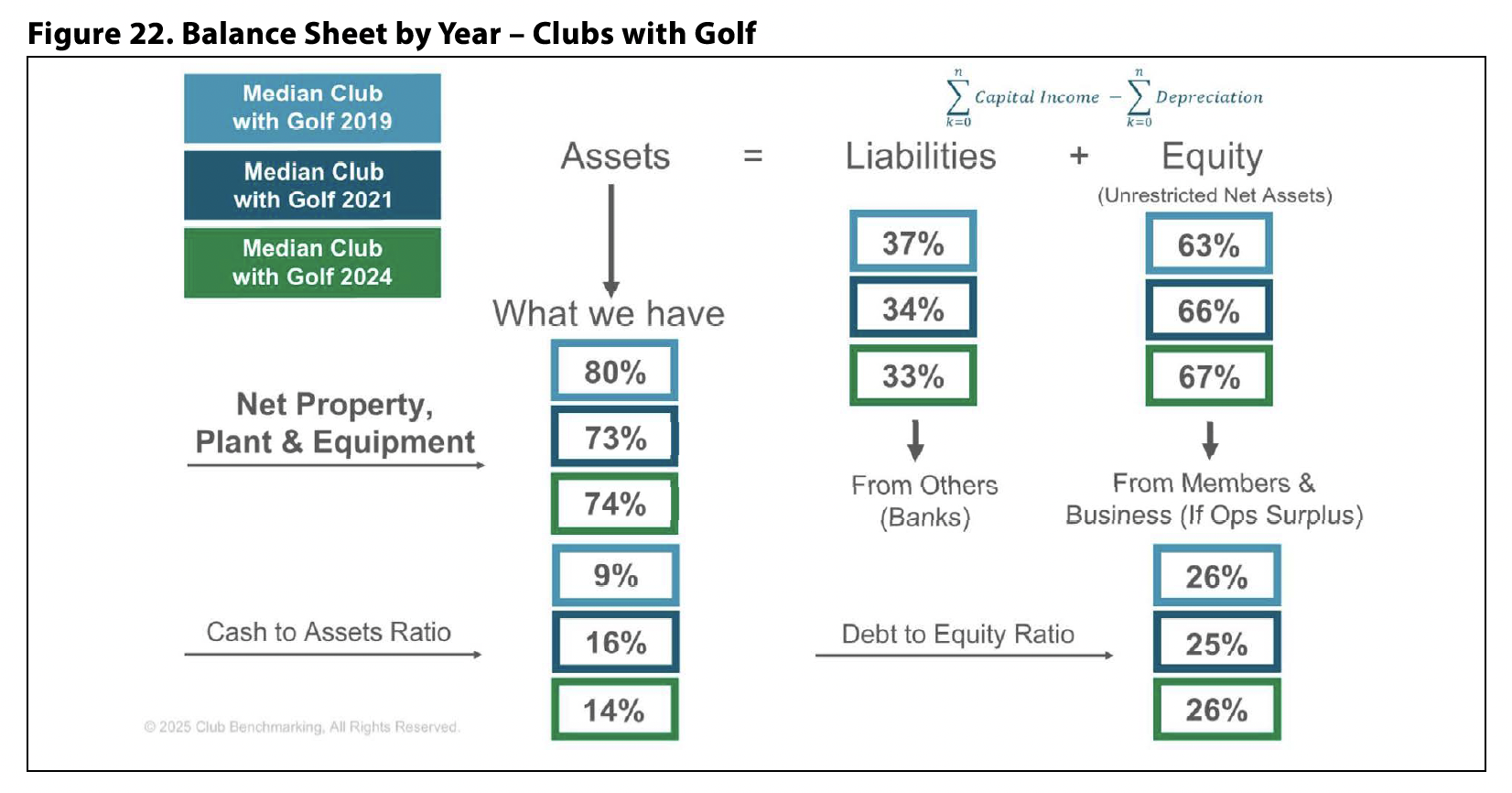
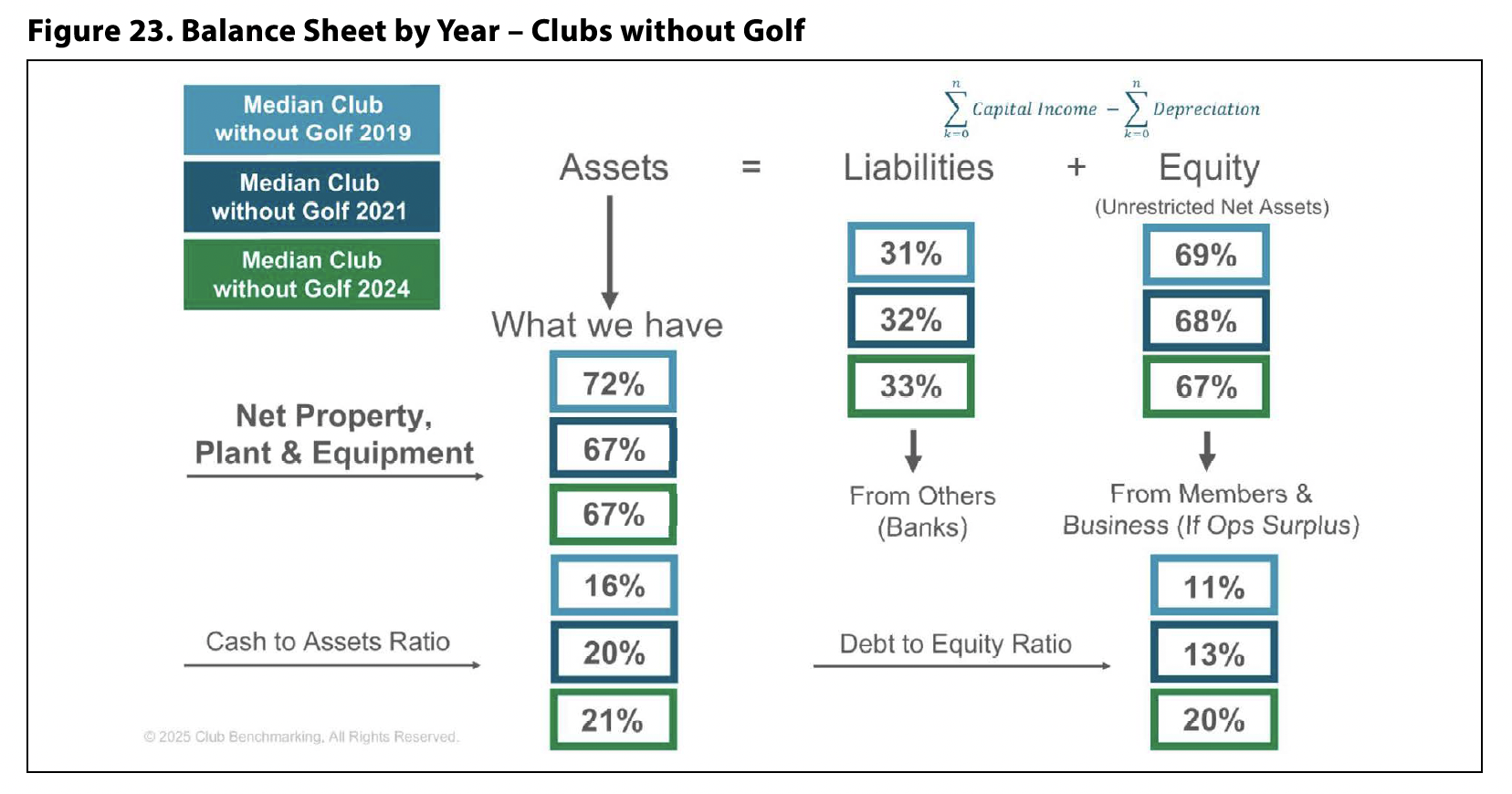
- The median club has 73 percent of total assets invested in Net PP&E, representing the depreciated book value of physical assets.
- The Net-to-Gross PP&E Ratio is 48 percent for clubs with golf and 47 percent for clubs without golf, as shown in Figures 22 and 23.
- At the median club, 67 percent of PP&E is funded through member capital contributions, with the remaining 33 percent funded by third-party debt (typically bank or lease debt).
Declining Net Worth often manifests itself in the form of deteriorated assets. Flat Net Worth results in deferred maintenance and gradual decline. Clubs must ensure Net Worth grows in alignment with a capital plan that anticipates assets replacement before failure. Reactive replacements, such as emergency HVAC repairs, are more costly and disruptive than planned investments.
Debt-to-Equity Ratio and Club Culture
The Debt-to-Equity ratio reflects how reactive a club has been in its capital planning. Clubs that rely on debt to fund Obligatory Capital are shifting the financial burden from long-standing members to newer ones. This ratio also reveals cultural dynamics (clubs with members unwilling to contribute capital often resort to external financing) which can compromise long-term sustainability.

Best Practices
Reimagining Your Summer Seasonal Racquets Program: Part Two
Summer racquets programs at seasonal clubs often fall into predictable patterns. Over time, even well-intentioned programming can begin to feel repetitive as the same events, formats, and schedules are repeated year after year. In other cases, the challenge arises during leadership transitions when a new professional steps into a club with long-standing traditions and established member expectations.
The Modern Pro Shop Model
Retail within racquets departments is evolving. Members today are accustomed to purchasing equipment and apparel online, making it difficult for traditional pro shop models to compete directly with large digital retailers.
Forward-thinking clubs are shifting toward hybrid retail strategies that include:
- Curated inventory aligned with member preferences
- Online ordering integration supported by limited on-site inventory
- Event-driven retail opportunities such as demo days and fitting events
- Pre-order seasonal merchandise packages
In this model, retail supports programming and member engagement rather than operating as a stand-alone revenue center.
Racquets as a Lifestyle Platform
Across the club industry, racquets programming is evolving beyond traditional instruction-based models. Modern memberships include a broad mix of lifestyles and schedules.
These often include:
- Retired members with daytime availability
- Professionals commuting to offices part-time
- Hybrid and remote workers with midday flexibility
- Families participating through junior and camp programs
Effective racquets departments respond to these patterns with programming that includes midday leagues, skill-based group play, targeted clinics, and opportunities that encourage participation across multiple racquet sports.
Increasingly, racquets serves as a lifestyle platform within the club rather than simply a lesson-based service.
The Expanding Role of the Racquets Director
The responsibilities of a modern Racquets Director have expanded well beyond on-court instruction. Today’s leaders must function as department managers responsible for both programming and operations.
Key responsibilities often include:
- Managing seasonal and part-time staff
- Overseeing junior development pathways
- Designing structured programming calendars
- Coordinating event promotion and member communication
- Managing court utilization and maintenance standards
- Evaluating member skill levels and placement
- Scheduling courts, clinics, lessons, and events
High playing ability alone is no longer sufficient preparation for this role. Leadership, operational oversight, and program design are now equally important.
The Manager’s Oversight Role
Many club managers come from backgrounds in golf operations or food and beverage. As a result, racquets departments are often entrusted to operate independently under the leadership of the Racquets Director.
In many cases this model works well. However, challenges can emerge when:
- Lesson revenue becomes the primary focus of the department
- Programming stagnates and fails to evolve
- New members are not integrated effectively
- Court standards begin to decline
- Directors lack experience operating within seasonal club environments
Without a clear seasonal framework, managers may lack the structure necessary to evaluate racquets department performance effectively.
Technology as an Operational Tool
Club technology platforms remain underutilized in many racquets programs. Most systems provide capabilities that can significantly improve organization and member engagement.
These typically include:
- Online lesson reservations
- Structured open play registration
- Event registration and promotion
- Revenue reporting and participation analytics
- Push notifications and targeted messaging
- Weather and court availability alerts
- Member activity tracking and participation data
When used effectively, technology improves operational efficiency while strengthening member communication.
A Strategic Approach to Racquets Programming
Highly successful racquets programs do not evolve by accident. They are structured, measured, refreshed annually, and supported by clearly defined standards. The goal is not to replace tradition. The goal is to protect it while modernizing the surrounding experience to meet evolving member expectations. When a racquets program begins to feel overly comfortable, it may be time for a strategic review. Stability is valuable, but comfort alone should never replace thoughtful planning.
Best Practices by James McDonald, RSPA Elite Pro, IPTPA, RSPA Padel, Strategic Club Solutions Racquets Resources

External & Governmental Influences
The Official End of the 2024 Overtime Regulations
On May 15, the Department of Labor rescinded the 2024 overtime rule, officially erasing a proposal that would have significantly increased salary thresholds and created a triennial automatic update for the threshold. The overtime rule regulates which employees are exempt from the payment of overtime by meeting the duties test and qualifying minimum salary threshold.
A federal judge first vacated the rule in November 2024, invalidating the increased salary thresholds and triennial automatic updates. The ruling was effective nationwide and restored the 2021 established threshold of $35,568 annually (or $684 weekly) for exempt employees and $107,432 annually for highly compensated employees.
In December 2024, the Biden Administration announced that it would appeal the ruling. In April 2025, the Trump Administration halted the appeal of 2024 overtime rule. With the official withdrawal of the rule, it is unlikely that additional overtime changes will be proposed as the Trump Administration set the previously established thresholds in 2019.
DOL’s Proposed Independent Contractor Regulations
On April 28, the Club Management Association of America, the National Club Association, and the National Golf Course Owners Association filed joint comments with the Department of Labor (DOL) in response to its proposed revisions to its analysis for determining employee and independent contractor classifications under the Fair Labor Standards Act, released in March.
“We applaud the DOL’s proposal to reinstate the 2021 Rule’s identification of two “core” factors in the Fair Labor Standards Act’s multi-factor economic reality test when determining worker classification. These core factors focus on the nature and degree of the worker’s control over the work; and the worker’s opportunity for profit or loss based on initiative and/or investment.,” read the comments in part.
The Associations further urged careful consideration for the application of the permanence factor to seasonal industries like golf and club, noting that “Many independent contractors choose to return to the same facility year after year based on mutual agreement, not economic dependence. In these cases, both parties retain the freedom to engage or not engage each season. Treating this type of recurring relationship as evidence of employment risks mischaracterizing legitimate independent business arrangements.”
The DOL accepted public comments on the proposed rule through April 28.
CMAA News & Announcements
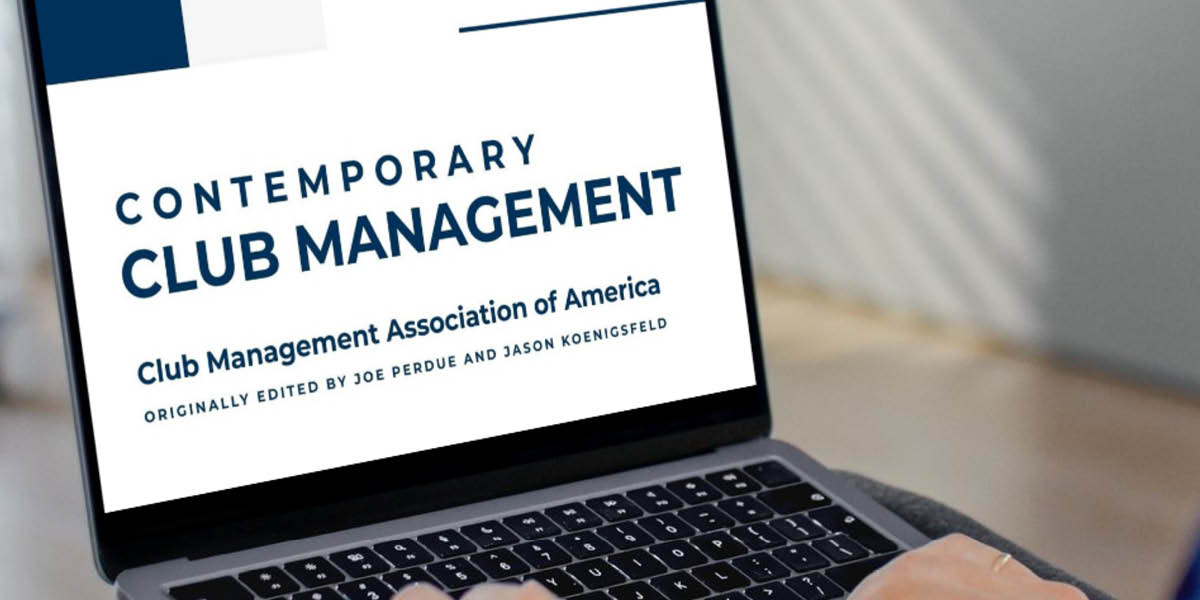
Dynamic Fourth Edition of Contemporary Club Management Now Available
CMAA announces the release of the Fourth Edition of Contemporary Club Management, the definitive, comprehensive resource on private club operations, covering leadership, food and beverage, golf operations, and finance.
The Fourth Edition will be released in phases, with revised chapters replacing previous versions as they are finalized. All content aligns with CMAA certification standards, and members preparing for the Certified Club Manager (CCM) exam will be notified of any relevant updates.
To date, the following chapters are complete:
Chapter 1: Overview of Private Clubs and Their Operations
Chapter 2: The Board of Directors and the Chief Executive
Chapter 6: Club Marketing
Chapter 7: Membership Marketing
Chapter 8: Building Human-Centered Teams in Private Clubs
Chapter 9: Training and Professional Development in Clubs
Chapter 10: Club Food & Beverage Operations
Chapter 11 (Part 1): Accounting Fundamentals & Financial Operations for Club Management
Chapter 11 (Part 2): Performance Management and Corporate Governance Principles
Chapter 15: Golf Course Maintenance
Chapter 16 (Part 1): Fitness, Wellness, Aquatics, Spa, and Performance Operations
Chapter 16 (Part 2): Racquet Sports
A one-time subscription payment of $85 provides continued access to the textbook through an online TopHat account, including automatic access to all future updates and new editions at no additional cost.
Learn more and explore the features of the online textbook by watching the brief tutorial video

Upcoming Governance & Leadership Symposium on July 22
CMAA’s next Governance & Leadership Symposium on July 22 offers accessible, collaborative, virtual education for club Board of Directors and club executives. Attend from anywhere with an Internet connection.
Past attendees highly rate these sessions. John Wilkening, CCM, shared “The Governance & Leadership Symposium should be required education for all incoming Board members as well as any club management profession.”
Explore important strategic governance topics built on the principles of:
- Informed Leadership
- Strategic Stewardship
- Empowered Management and Staff
- Compelling Member Experience
Leave this symposium more informed and equipped with key takeaways for improving club governance. The Symposium is presented in partnership with KOPPLIN KUEBLER & WALLACE, a CMAA Executive Partner.