
Board Brief
May 2026
Designed for Club Board of Directors

Inside this Issue:
-
Insights: Three Factors That Help Your Club Capitalize on the Workplace Evolution
Three factors poised to support your club members’ continued demand for flexible work scheduling enable private clubs to continue to benefit from the Covid-inspired surge in demand for club membership and usage. -
By the Numbers: The Purpose of the Capital Ledger and Balance Sheet KPIs
Both logic and data confirm that the capital ledger is the true source of funding for reinvestment. -
Best Practices: Reimagining Your Summer Seasonal Racquets Program: Part One
Programming strategies should reflect those differences rather than relying on a one-size-fits-all approach. -
Podcast Spotlight: Leaning into Employee Safety
In this episode, we’re joined by Alan Achatz, CCM, CHE, to discuss some of the perennial safety issues clubs face. -
CMAA News & Announcements: Is a Renovation Project on the Horizon for Your Club?
Get the blueprints to make your club’s next project a success at the Capital Improvements Symposium.

Insights
Three Factors That Help Your Club Capitalize on the Workplace Evolution
Three factors poised to support your club members’ continued demand for flexible work scheduling enable private clubs to continue to benefit from the Covid-inspired surge in demand for club membership and usage. Alert operators will think ahead of members’ needs to bring focus and emphasis to using the club whenever possible.
Hybrid is king… for now. Balancing companies’ needs with workers’ desires, the hybrid approach to work scheduling. According to multiple research sources, the most common approach is three days per week. Fully remote roles have shrunk considerably.
Your club can seize on four important initiatives immediately:
- Expanded “weekend” activities and usage. Mondays and Friday have become “shoulders” for the traditional weekend days of Saturday and Sunday. Develop expanded weekend events and programs. Think of your club’s calendar as a bucket to be filled with new programs and opportunities that make your club more relevant to members.
- Morning (or afternoon) fitness programs. Move fitness demand out of the traditional 5:00–9:00 a.m. or the 5:00–7:00 p.m. windows. Introduce new training programs, concepts, and trainers to these time windows.
- Transitional opportunities programming. Members who are transitioning from full-time careers or part-time work may be interested in a regular program of semi-retired work alternatives. They may want to learn more about their options at their respective stages of life.
- Lifelong learning programming. Brain health and mental fitness will become ever more provocative as more Baby Boomers retire. Focus your members on their mental health opportunities.
Worker flexibility is shrinking. In the face of growing employer demands for full return to office, most workers are now required to be at the office more of the workday.
Note that eventual demands will increase and impact your club’s budget. Prepare now with programs that sustain members’ use of the most popular amenities and programs, despite RTO demands. Three options worth considering:
- “Free” breakfast for those on the way to the office. Make your club the first stop for your members who are otherwise stopping at Starbucks.
- Happy hour options that enable members to stretch their workdays by finishing their days at your club.
- Develop AI-training programs and tutorials at the club to help members find shortcuts and alternatives that preserve time for them at the club.
“Office peacocking” is growing. Sprucing up workspaces, employers are upgrading workspaces, technologies, and amenities, such as childcare, fitness, and break areas/menus. Experts refer to this trend as “peacocking.”
Your club is competing with these office upgrades. Make your club the easy-to-use option for people who need to be accessible to work through certain technologies. Improve the club’s bandwidth and professional amenities to make working-from-the-club a preferred alternative. Upgrade chairs and desktops/workspaces to make them comfortable and discreet.
It is certain that work demands will change and can impact your club. Whether the impacts are favorable or unfavorable will depend on the choices you make ahead of the changes.
Insights by Henry DeLozier, Partner, GGA Partners

By the Numbers
The Purpose of the Capital Ledger and Balance Sheet KPIs
From July 2024-June 2025, CMAA and Club Benchmarking collected data from more than 1,200 clubs for the 2024 Club Finance and Operations Survey. In this edition of Board Brief, we will dive into understanding the purpose of the capital ledger and balance sheet KPIs.
Capital Generation and Long-Term Sustainability
For clubs to thrive over the long term, they must consistently generate funds that can be invested into infrastructure, services, and strategic initiatives. The operating ledger typically does not produces these reinvestment dollars. Both logic and data confirm that the capital ledger is the true source of funding for reinvestment.
Club Benchmarking uses Net Available Capital as a key performance indicator (KPI) to assess a club’s financial flexibility and its ability to reinvest in its future. This KPI measures the capital available for:
- Capital investment
- Debt repayment
- Building cash reserves
Net Available Capital = Total Capital Income + Operating Result (with interest treated as an operating expense) - All Lease Payments
This metric reveals how much power the capital ledger, the club’s financial engine, is generating to support growth, stability, and long-term reinvestment.
The Balance Sheet: A Window into Financial Health
The Balance Sheet provides a deep view into a club’s financial health and sustainability. It highlights foundational concepts that, when fully understood and embraced, support sound financial decision-making over time.
Net Worth Over Time (NWOT)
NWOT is a long-term KPI that reflects a club’s financial trajectory and the influence of its culture and decision-making. Club Benchmarking has tracked NWOT for approximately 1,400 clubs. NWOT trendlines are plotted back to 2006 to include the impact of the 2007-2008 financial crisis, offering meaningful context for evaluating resilience and strategic direction.
Depreciation and Net Available Capital
Approximately 75 percent of clubs do not achieve a positive financial outcome on the operating ledger when depreciation is included. Under GAAP, a club can only report a profit after depreciation if Net Available Capital exceeds depreciation expense.
- If Net Available Capital > Depreciation → Net Worth increases
- If Net Available Capital < Depreciation → Net Worth declines
- If equal → Net Worth remains unchanged
These dynamics underscore the importance of generating sufficient capital to maintain or grow a club’s financial position.
Targeting Net Worth Growth
To maintain physical assets in good condition, Net Worth should grow at a Compound Annual Growth Rate (CAGR) of at least 3.3 percent, which aligns with construction inflation.
To support the addition of new amenities, such as casual dining, fitness and wellness, resort-style pools, pickleball and padel, and tech-enabled golf learning centers, Club Benchmarking recommends targeting a Net Worth CAGR at or above the 75th percentile for the industry.
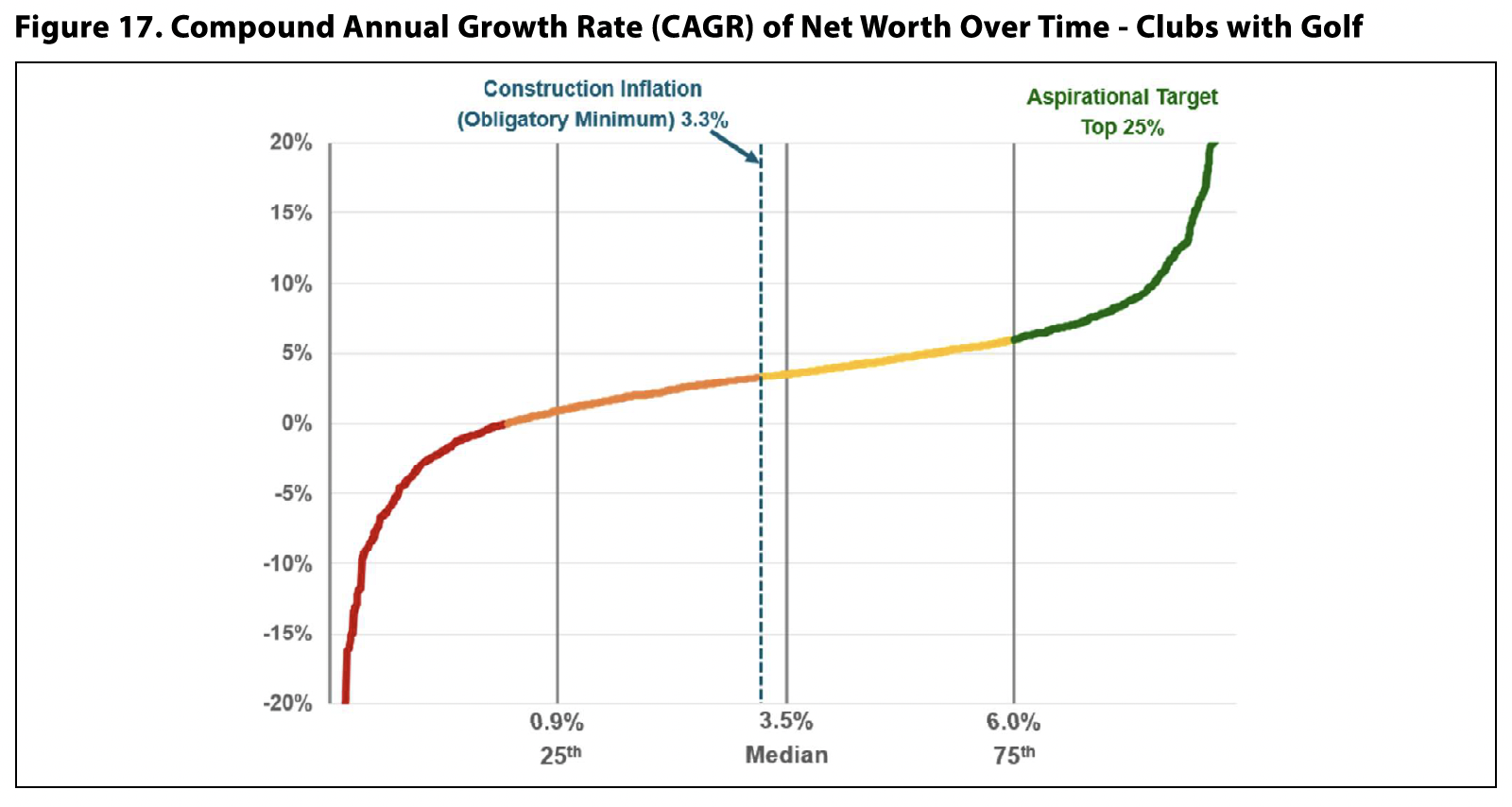
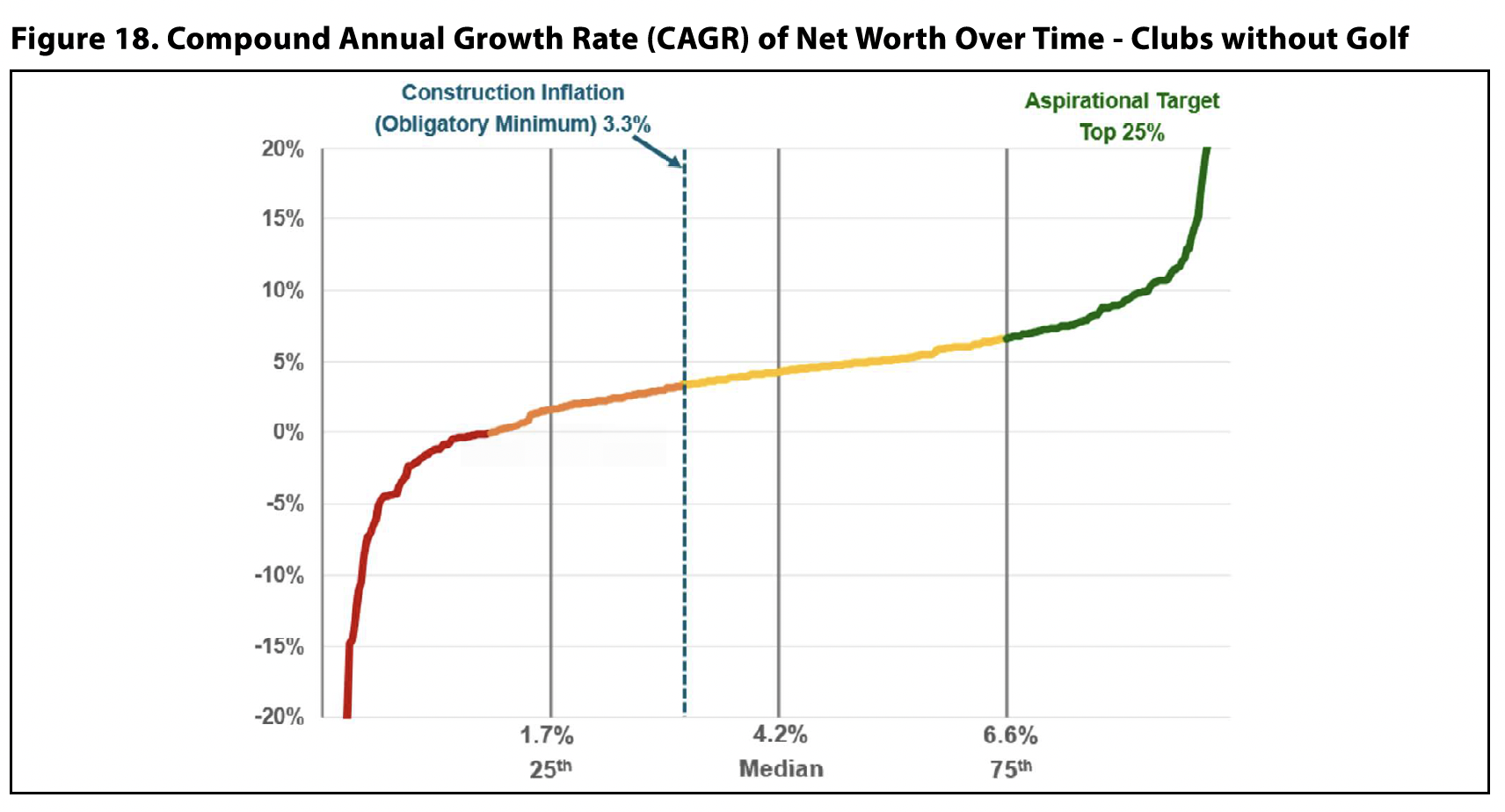
Figures 17 and 18 present the Compound Annual Growth Rates (CAGR)since 2006 for clubs with golf and clubs without golf, respectively.
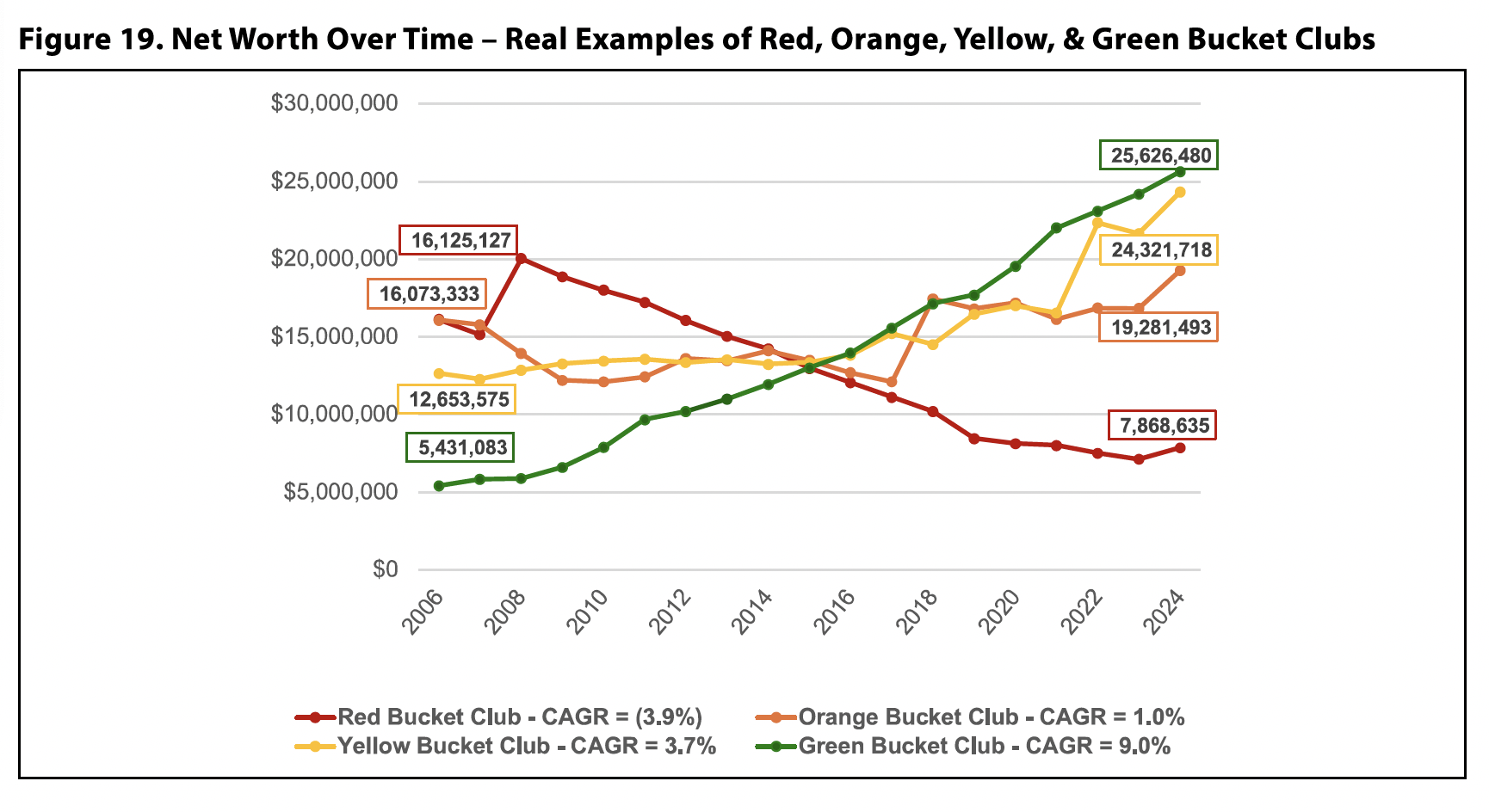
Figure 19 represents four real examples of clubs with declining Net Worth, flat Net Worth, and Net Worth growth exceeding 6.2 percent, which represents the industry’s upper quartile.
Want to dig into all the survey findings? CMAA members can access the complete FY2024 Finance and Operations Report.

Best Practices
Reimagining Your Summer Seasonal Racquets Program: Part One
Summer racquets programs at seasonal clubs often fall into predictable patterns. Over time, even well-intentioned programming can begin to feel repetitive as the same events, formats, and schedules are repeated year after year. In other cases, the challenge arises during leadership transitions when a new professional steps into a club with long-standing traditions and established member expectations.
Every seasonal club operates with its own rhythm. Some concentrate activity in the early morning hours before the heat sets in. Others see strong junior participation tied to camp programming. Some memberships skew older while others are becoming increasingly multi-generational. The energy, participation patterns, and daily cadence of each club vary significantly. Programming strategies should reflect those differences rather than relying on a one-size-fits-all approach.
Staffing structures can also vary widely. One club may have a racquets professional who has served the membership for many years and understands the nuances of the community. Another may be led by a first-time director or a professional new to the seasonal club environment. Neither scenario is inherently problematic. However, both benefit from clearly defined structure, operational standards, and thoughtful oversight.
For many clubs, the core challenge becomes sustaining energy and innovation within a membership that is also deeply connected to tradition.
The Importance of a Seasonal Programming Framework
Successful seasonal clubs rarely operate without structure. Their racquets programming is built around a clear framework that balances tradition with innovation.
That framework typically includes:
- Legacy events members look forward to each season
- Technology-supported formats that improve organization and participation
- Structured pickleball programming including managed open play and drill-based formats
- Cross-sport activation across tennis, pickleball, padel, platform tennis, and squash where applicable
- Defined court maintenance standards
- An integrated retail approach tied directly to programming
Without this structure, racquets programming often becomes reactive. Events are scheduled week-to-week rather than as part of a cohesive seasonal strategy.
Court Maintenance Reflects Club Standards
Court conditions play a significant role in the overall racquets experience. At many seasonal clubs, court maintenance responsibilities fall to teaching professionals who may have limited experience managing clay surfaces.
Improper morning preparation can lead to dead material buildup, ridge formation, and long-term surface deterioration. Perimeter areas and fencing can also become overlooked, allowing moss, algae, and weeds to develop.
Court presentation is not simply aesthetic. It communicates standards and reinforces the quality of the club experience.
Read next month for Part Two of this article.
Best Practices by James McDonald, RSPA Elite Pro, IPTPA, RSPA Padel, Strategic Club Solutions Racquets Resources
Podcast Spotlight
Leaning into Employee Safety
In this episode of Let’s Talk Club Management, we’re joined by Alan Achatz, CCM, CHE, to discuss some of the perennial safety issues clubs face. Alan is the founder of Club Safety Solutions, LLC, whose primary mission is bringing safety knowledge to businesses through managerial and line employee education sessions. As we learn in this conversation, safety is as much a part of club culture as anything else—and Alan takes us through how clubs can establish a solid approach to safety with their staff team.

CMAA News & Announcements
Is a Renovation Project on the Horizon for Your Club?
Get the blueprints to make your club’s next project a success at the Capital Improvements Symposium. Hosted at The Chicago Club in Chicago, IL, August 9-11, this event will help your management team build the competencies needed to lead your club’s next project, renovation, or deconstruction. Topics will be diverse and extensive and cover every aspect from start to finish including obtaining member approval for the project, contracts/draw schedule, project cost estimating, assembling the team and roles and responsibilities, financing, feasibility and valuation, and project management.
For more information, accommodations, and registration
