
Board Brief
September 2026
Designed for Club Board of Directors

Inside this Issue:
-
Insights: Beyond Succession: Leading Through Executive Transition
The retirement of a long-tenured General Manager/COO creates a defining moment in a club’s history. While the natural inclination is to focus on the immediate hiring of a new executive, boards must focus on leading the club through the transition itself. -
By the Numbers: How Facilities Impact Finance & Operations
We’ll explore the impact of the expenses around facilities on club finances. -
Best Practices: Generation Gaps in Your Club—Intergenerational Harmony and Where to Find It (Part Two)
Three approaches enable club managers to navigate today’s private club generational gaps. -
External & Governmental Influences: Upcoming Governance & Leadership Symposium on November 19
Your club’s efforts should begin with preparation and education. -
CMAA News & Announcements: How CMAA Membership Benefits Your Club
It is the time of year when Club Management Association of America (CMAA) members renew their connection to CMAA. As a Board member, you may be curious about CMAA’s value to your club.

Insights
Beyond Succession: Leading Through Executive Transition
The retirement of a long-tenured General Manager/COO creates a defining moment in a club’s history. While the natural inclination is to focus on the immediate hiring of a new executive, boards must focus on leading the club through the transition itself.
Over time, successful, highly regarded leaders become a part of the fabric of the club and the club’s identity. They have cultivated trusted relationships with the members, mentored employees, defined the organizational culture, and provided a level of institutional knowledge that cannot be replaced. As a result, leadership transitions are not only strategic decisions but are also human ones as they naturally evoke a level of emotion from Boards, staff, members, and both the outgoing and incoming leaders alike. Acknowledging the emotions and creating awareness and discussion around the transition will help to calm anxiety and prepare everyone to positively embrace a new path forward in the history of the club.
At many clubs with long-tenured executives, the existing leadership team has only worked for one General Manager/COO. They may not fully understand the board’s vision and often have strong relationships with the members and directors. Clear communication and visible board support are key and will help the new General Manager/COO build trust and credibility.
One common mistake Boards make is to seek out an individual who mirrors the same style and presence as the outgoing General Manager/COO, and/or seeks someone who is the opposite of the outgoing leader. The focus should not solely be on style and personality, but on the attributes, expectations, and priorities required to successfully lead the club into the future. Boards should do a deeper dive and ask themselves: “What kind of leadership does our club need for the next decade?”
Once the placement is finalized, the success of the General Manager/COO is determined by how well the individual is onboarded and assimilated into the club. Boards often overlook this, and the General Manager/COO is left to navigate expectations and relationships without a structured plan for success. Additionally, should changes be warranted, the pace of change should be intentional, thoughtful, and fully supported by the Board. This positions the new leader for long-term success, instead of pressuring the new General Manager/COO into short-term decisions that could undermine the club and his or her position. Recognizing that he or she is not a continuation of the past, but the leader entrusted with shaping the club’s future is essential. Providing that executive with the Board’s full support and confidence is critical to the success of the General Manager/COO and the organization.
Strong Boards recognize that succession is more than filling a position. It is an opportunity to honor the history, embrace the future, and thoughtfully steward the club into its next era.
Insights by Marcie Mills, CCM.
Marcie Mills, CCM, is a Search & Consulting Executive with KOPPLIN KUEBLER & WALLACE with more than 25 years of leadership experience in hospitality and private club management. A recognized industry educator, she has served as General Manager/COO at several premier private clubs, leading transformative capital projects, operational excellence, and member-focused initiatives. An active leader within the Club Management Association of America (CMAA), Marcie is passionate about education, mentorship, and advancing the club management profession. In 2025, she was honored by BoardRoom magazine with the Gary Player Award as Educator of the Year for her outstanding contributions to the industry.

By the Numbers
How Facilities Impact Finance & Operations
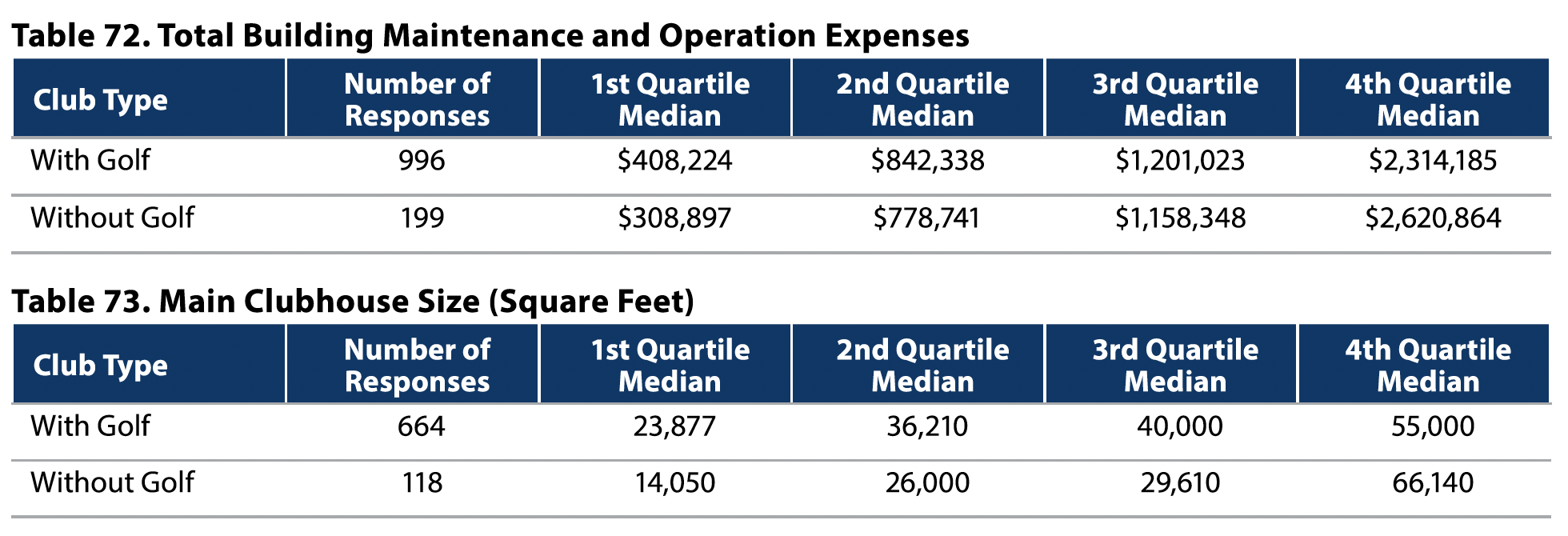
From July 2024-June 2025, CMAA and Club Benchmarking collected data from more than 1,200 clubs for the 2024 Club Finance and Operations Survey. In this edition of Board Brief, we’ll explore the impact of the expenses around facilities on club finances.
Buildings and Maintenance
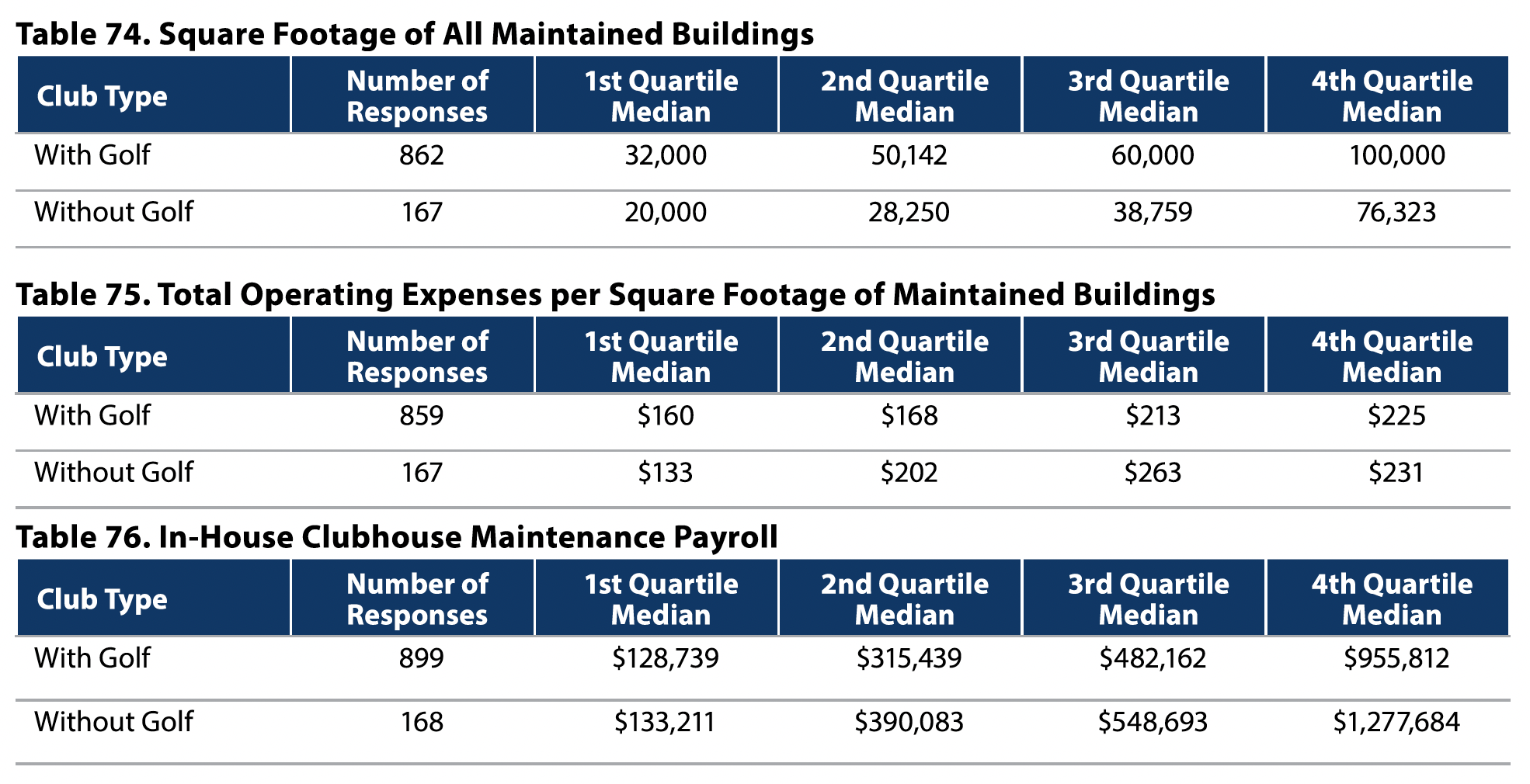
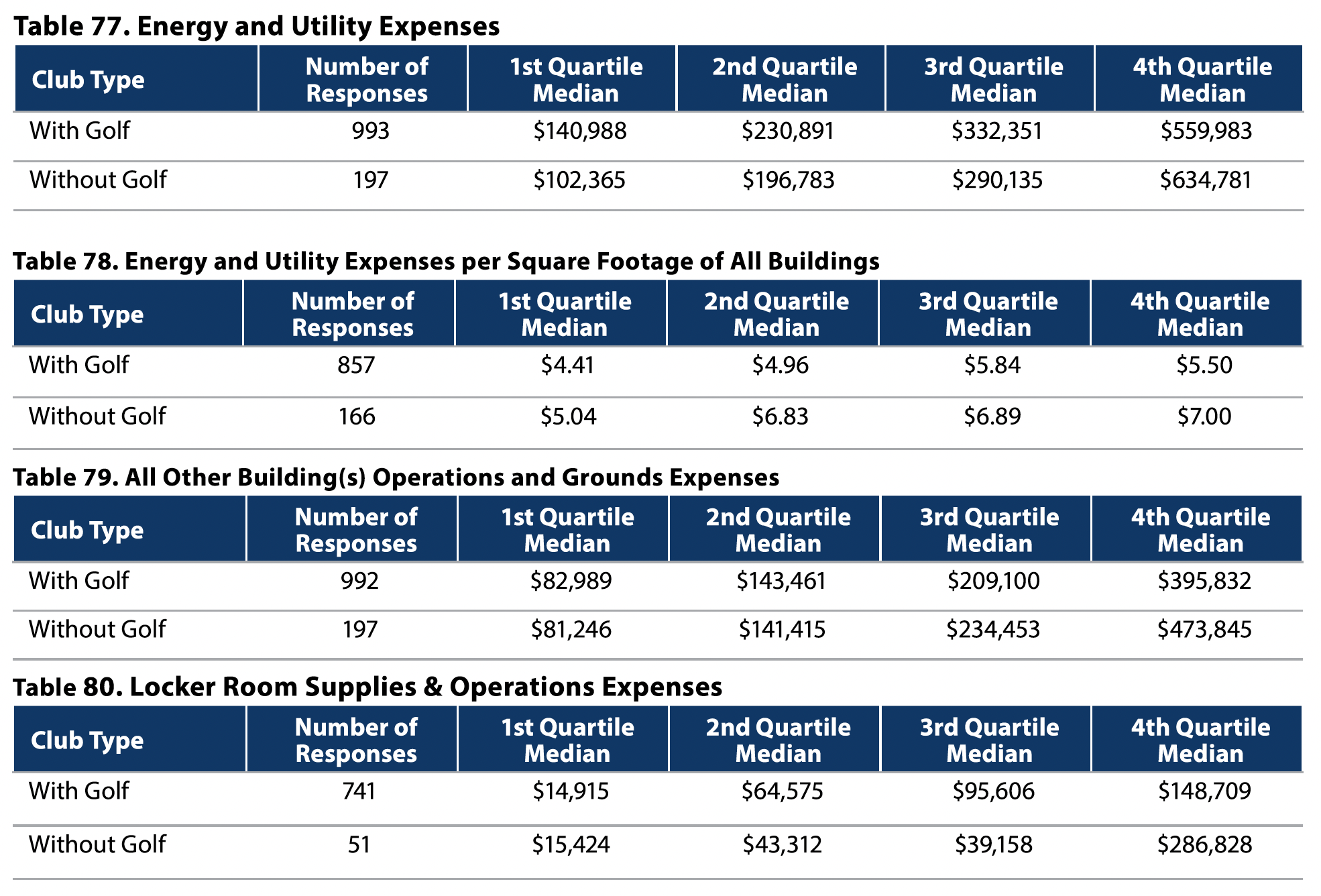
Tables 72 through 80 summarize Buildings Maintenance and Operations expenses and other details. These include Total Buildings Maintenance and Operations Expenses, Main Clubhouse Age, Main Clubhouse Size, Square Footage of All Maintained Buildings, In-House Clubhouse Maintenance Payroll, Energy and Utility Expenses, All Other Building(s) Operations and Grounds Expenses, and Locker Room Supplies and Operation Expenses. Each table covers all respondents and provided data.
Guest Rooms
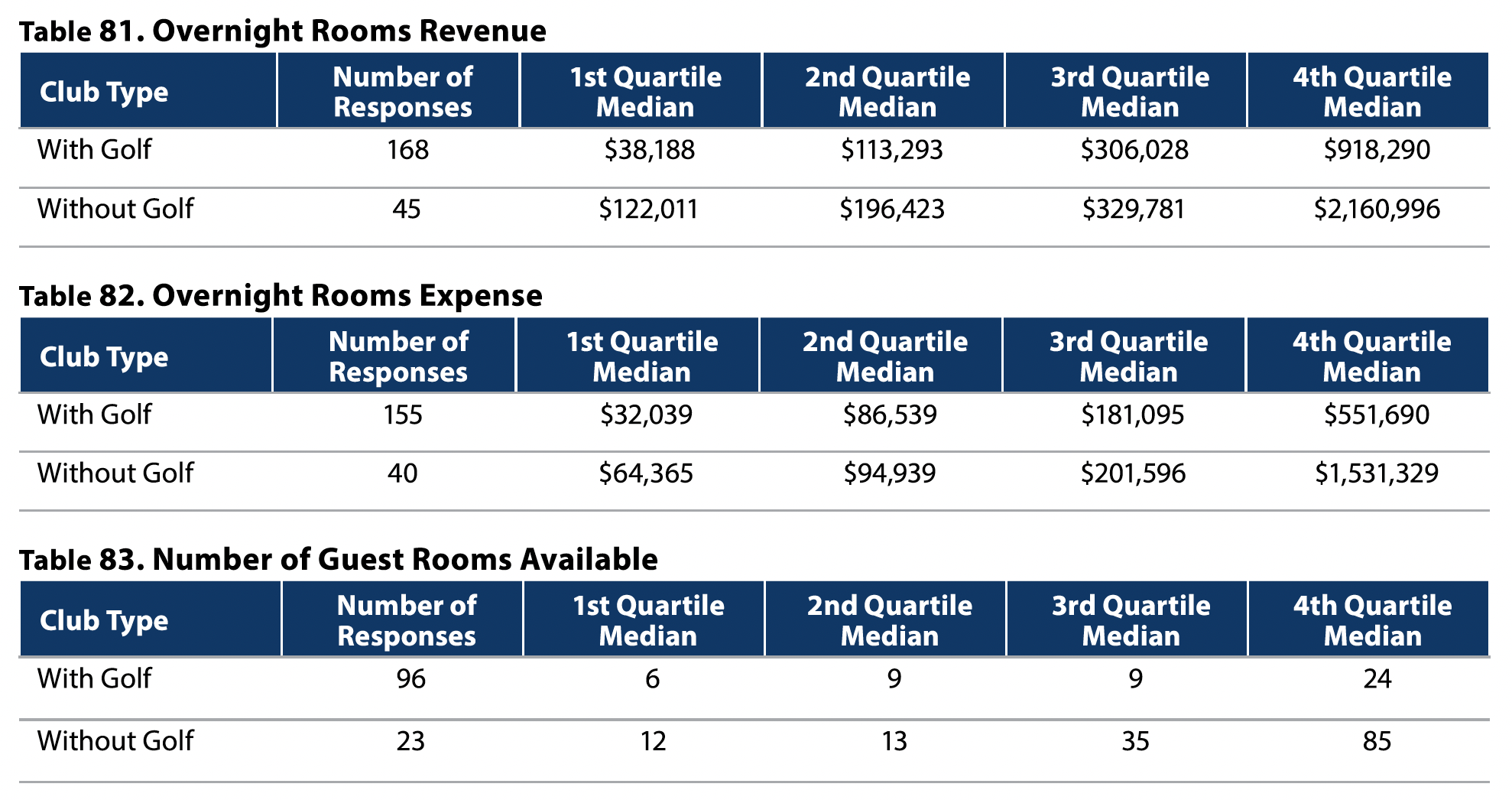
A total of 18 percent of all respondents (213) reported having guest rooms. Responses for all clubs (with and without golf) are shown by revenue segment in Table 81.
Tables 82 and 83 show the quartile breakdown of data for all clubs that have indicated having guest rooms, with not all respondents indicating how many guest rooms they have. The median annual room revenue for Clubs Without Golf is $286,157. Overnight rooms are an important source of revenue for many City Clubs.

Best Practices
Generation Gaps in Your Club—Intergenerational Harmony and Where to Find It (Part Two)
Editor’s Note: This is the second part of a two-part series regarding current generational differences in private clubs. Read Part One in the January 2026 edition of Board Brief.
Previously, Board Brief explored the generational gaps evident in most private clubs. The gaps require club leaders and managers to—first—recognize and understand the generational perspectives and needs. Then, develop and successfully implement solutions that enable members of whatever age group to find friendship, fun, and purpose in their clubs’ membership offerings.
Solutions
Three approaches enable club managers to navigate today’s private club generational gaps.
-
Recognition: Using empathy, understanding, and patience, club managers should identify the generational divide and openly acknowledge differences that exist. While most members recognize the change, they disavow their part in the divide.
Three tactical solutions are proving effective in clubs throughout North America:
-
Identification—First, everyone wants to be recognized and called by name…regardless of their age. As private clubs more effectively put member identification capabilities to work—such as personal profiles for each member and spouse, getting-acquainted events, and using artificial intelligence to enable accurate repetition and usage measurement.
-
Planning—Second, members of all ages need a facilitated lifestyle…they want and need the club’s staff to organize and conduct events and activities that bring people like them together. Whenever practical, members like to be a part of the planning steps. Inclusion encourages greater engagement for members who recruit their friends’ participation and insight for what members want.
A key element in successful event planning is engagement. Calling members to action, getting the word out, and causing members to participate require members to help with the planning. Keep it efficient, simple, and fun.
-
Tracking—Third, measuring engagement is important for two reasons:
-
It validates that the planning and execution of the event were relevant to the targeted generational segment, and
-
It provides great insight for what members want and don’t want.
-
-
-
Dialogue: Noting that Boomers, who feel that they are being “pushed out” or “priced out,” seem to opt for loud and angry opposition to changes in their club, managers must establish a forum for genuine and truthful discussion. Managers will be sorely pushed to listen to all voices.
Organize listening sessions by generational segments. These events are ones in which members express their viewpoints regarding the club’s amenities and programs. Beyond the predictable concerns regarding fees and costs, members need to express what they value in the club and how the club can—and should—provide greater value.
Listen and provide written and video follow-up summaries that affirm that members are being heard. Deliver the summaries via email, on the club app, and in-person to ensure broad awareness.
-
Mutual Understanding: Helping all generational profiles to understand the economic impacts of their membership is essential to shared understanding. Boomers need to see a non-personal profile of their investment in the club to the financial investments being required of rising generations.
The key is that each generation understand the other and resolve to work together. Recognize that three rising generations follow the Millennials so these programs will have long usage lives.
Insights by Henry DeLozier, Partner, GGA Partners

External & Governmental Influences
Upcoming Governance & Leadership Symposium on November 19
Great club governance doesn’t happen by accident—it’s driven by intentional action. It requires deliberate focus and consistent investment from the club executive and the Board of Directors. Your club’s efforts should begin with preparation and education.
CMAA’s Governance & Leadership Symposiums offer accessible, collaborative, virtual education for your Board of Directors and club executive. Explore important strategic governance topics built on the principles of:
- Informed Leadership
- Strategic Stewardship
- Empowered Management and Staff
- Compelling Member Experience
CMAA’s next Governance & Leadership Symposium offers accessible, collaborative, virtual education for club Board of Directors and club executive. Attend from anywhere with an Internet connection.
Past attendees highly rate these sessions. John Wilkening, CCM, explains “The Governance & Leadership Symposium should be required education for all incoming Board members as well as any club management profession.”
Leave this symposium more informed and equipped with key takeaways for improving club governance.
Learn more and register by November 17.
The Symposium is presented in partnership with KOPPLIN KUEBLER & WALLACE, a CMAA Executive Partner.
CMAA News & Announcements
How CMAA Membership Benefits Your Club
It is the time of year when Club Management Association of America (CMAA) members renew their connection to CMAA. As a Board member, you may be curious about CMAA’s value to your club.
Founded in 1927 as the Club Managers Association of America, CMAA is the largest professional association for club management professionals with more than 8,700 members throughout the US and internationally. In 2018, CMAA became the Club Management Association of America, a name better representing the composition of its membership. Our members contribute to the success of more than 2,600 country, golf, athletic, city, faculty, military, town, and yacht clubs.
Featured Benefits for Your Club
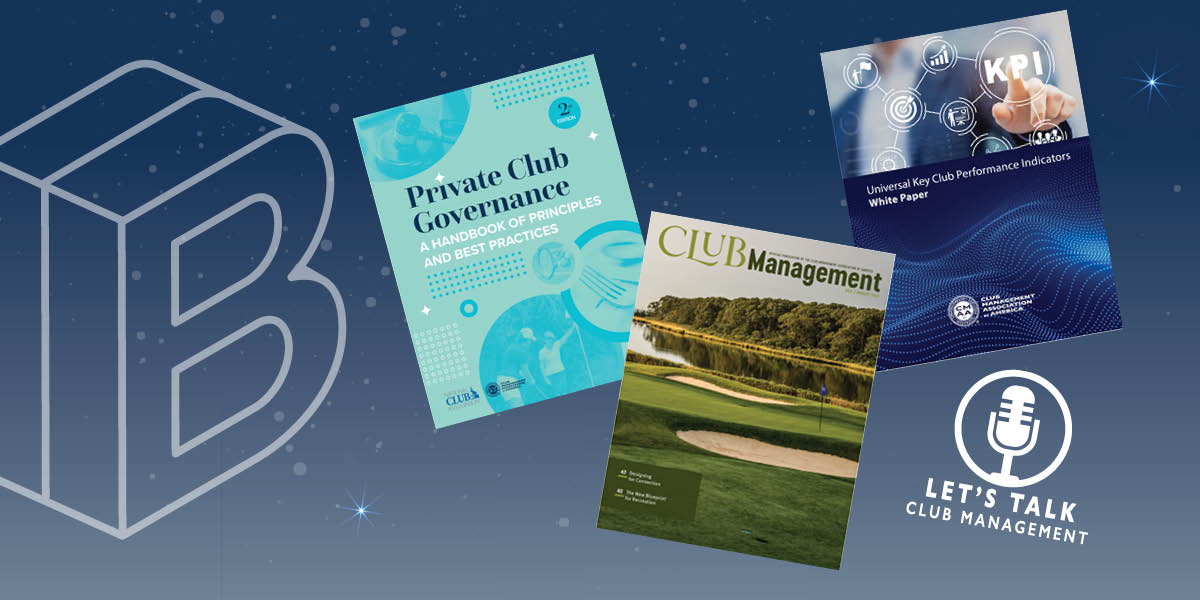
Board Resources: CMAA offers multiple informational sources for club boards, including this monthly publication Board Brief and the exhaustive Private Club Governance: A Handbook of Principles and Best Practices, now in its second edition. Additionally, CMAA offers multiple, virtual Governance & Leadership Symposiums to prepare club’s elected leadership for success.
Club Resources: CMAA members have access to a wide range of services designed specifically for clubs including staff training available through the Club Resource Center, employee 401(K) retirement plans, and comprehensive background screenings.
Educated Professionals: Professional Development is at the core of the CMAA’s mission. The curriculum is based on 11 competency areas covering all aspects of the club manager’s role. The Association delivers educational content in a variety of ways through five-day, university-based Business Management Institutes (BMI), Chapter and regional programs, conference education, summits, webinars, and online education. CMAA’s educational programming leads to its sought-after certification program; the Certified Club Manager (CCM) designation is the centerpiece of this program.
Research and Benchmarking: CMAA members have unlimited access to a robust database of club and hospitality-related articles, white papers, guidelines, and data covering every aspect of the club management universe. This includes the recently released Capital Improvements Handbook and the Universal Key Club Performance Indicators White Paper. CMAA conducts surveys on compensation and benefits, governance and policies, and finance and operations that are complimentary to clubs that participate.
Trends and Best Practices: Members can access publications like Club Management magazine, the searchable research archives, peer-tested club ideas in the Idea Fair, the Let’s Talk Club Management podcast, and much more. CMAA provides the latest information on understanding and complying with changing federal legislation, regulation, and legal mandates.
Clubs and their governing boards benefit directly by having a CMAA-educated professional(s) at the helm. Encourage your club management professionals to renew their membership by October 31!