Board Brief
August 2026
Designed for Club Board of Directors

Inside this Issue:
-
Insights: The Importance of Good Governance in Private Clubs and Communities
Let’s start from the beginning: Most clubs and communities are organized under a variety of tax and legal structures. Regardless, they occupy a unique space in society. -
By the Numbers: How Membership Impacts Finance & Operations
We’ll explore the impact of Food and Beverage (F&B) on club finances. This report utilizes a standardized approach, measuring net F&B Surplus/Deficit as a percentage of Operating Dues Revenue. This metric helps provide context for evaluating whether F&B should be treated as an amenity or a profit center. -
Best Practices: Using Change to Your Advantage
In his 1988 bestseller, Thriving on Chaos: A Handbook for a Management Revolution, Tom Peters seemed to have investigated the lives of club managers when he recognized the ever-changing demands placed upon leaders with institutional scale and reach. Change, Peters observed, can be advantageous when one embraces its inevitability. -
External & Governmental Influences: House of Representatives Approves Sunshine Protection Act
On July 14, the House of Representatives approved the Sunshine Protection Act. This legislation was first introduced in 2025 and would make Daylight Savings Time (DST) the new permanent standard time. -
Podcast Spotlight: The Story Behind the Glass
We talk balancing tradition with evolving consumer expectations, especially in clubs where members value both heritage and new experiences, the trends we are seeing in wine preferences right now, and how technology can be used to improve wine education, service, and storytelling for members. -
CMAA News & Announcements: Nominations for the 2026 Club Executive of the Year Nominations Due September 10
Do you know a club management professional who sets the standard for excellence? It’s time to recognize and honor their contributions!

Insights
The Importance of Good Governance in Private Clubs and Communities
Let’s start from the beginning: Most clubs and communities are organized under a variety of tax and legal structures. Regardless, they occupy a unique space in society. These largely social clubs, ranging from golf and yacht clubs to dining and racquet clubs, exist to promote fellowship and recreational activities among members. While most are tax-exempt, their operations must meet legal and operational standards to retain their status. The business model for most club and community structures is fraught with conflict. Volunteer members (customers and owners in most cases) serve to make decisions about a business for which they often have no professional experience, and their choices face scrutiny by their peers on the first tee and in the dining room. Therefore, at the heart of long-term sustainability for these clubs and communities is one critical factor: good governance.
Why Governance Matters in Private Clubs
Governance refers to the structures, policies, processes, and behaviors that guide decision-making, oversight, and strategic direction. For most clubs and communities, governance isn’t just a matter of administrative organization; it’s fundamental to their legal compliance, financial stability, management, and member trust.
Clubs that embrace good governance are more agile, transparent, and aligned with member interests. Those who don’t risk stagnation, conflict, legal missteps, and financial instability.
Key Challenges Unique to Private Clubs and Communities
Unlike for-profit businesses or even other types of non-profits, clubs face governance challenges specific to their nature:
Volunteer leadership: Boards are often composed of well-meaning volunteers; many of whom may lack expertise in governance, finance, or non-profit law.
Member-driven culture: Club members are both the customers and the owners, leading to blurred lines between operational input and strategic oversight.
Legal requirements: Clubs must ensure that their net earnings do not benefit private individuals and that activities primarily serve members. Poor governance can lead to violations that jeopardize tax-exempt status or the integrity of good business practices as an employer.
Legacy thinking: In older clubs, “the way we’ve always done it” can be a recipe for disaster. Some can become stuck in tradition rather than being forward-focused and data-informed. While it is essential to preserve some traditions, integrating innovation is critical to long-term success.
The Pillars of Good Club Governance
Clearly Defined Roles and Responsibilities
A high-functioning board understands the difference between governance and management. Boards set strategy, policy, and fiduciary oversight. The General Manager, COO, or CEO executes operations. Clarity here avoids micromanagement and enables leadership to focus on their respective strengths.
Strategic Thinking with a Strategic Plan
Governance is not day-to-day problem-solving; it’s forward-looking stewardship. Good boards prioritize long-term planning, risk management, and financial sustainability through capital planning, reserve studies, and member engagement strategies.
Transparency and Communication
Members deserve to understand how and why decisions are made. Open communication fosters trust, reduces speculation, and ensures alignment between board decisions and member expectations.
Board Education and Succession Planning
Effective governance starts with informed leaders. Clubs should invest in board orientation and ongoing education about fiduciary duties, club trends, and governance best practices. Equally important is building a strong pipeline of future board members through robust nominating and leadership development processes.
Compliance and Risk Management
Governance includes ensuring the club adheres to IRS regulations, employment law, safety requirements, and environmental standards. Clubs should regularly review bylaws, policies, and operational procedures with legal counsel and industry experts.
Good Governance Outcomes
Strong governance doesn’t just prevent problems, it creates value. Clubs with disciplined governance practices:
- Make better, faster, and more strategic decisions.
- Retain and attract quality staff by providing clarity and consistency.
- Improve member satisfaction by aligning operations with the club’s mission and vision.
- Protect their tax-exempt status by ensuring compliance with regulations.
- More likely to succeed in capital campaigns and long-term financial planning.
Private clubs and communities cannot afford to overlook the importance of good governance. Well-governed clubs are not only more sustainable and resilient but also more capable of delivering the experience their members expect. As private clubs and communities evolve to serve new generations, governance will be the foundation upon which tradition and innovation successfully meet.
Insights by Ryan Doerr, President & CEO of Strategic Club Solutions

By the Numbers
How Membership Impacts Finance & Operations
From July 2024-June 2025, CMAA and Club Benchmarking collected data from more than 1,200 clubs for the 2024 Club Finance and Operations Survey. In this edition of Board Brief, we’ll explore the impact of Food and Beverage (F&B) on club finances. This report utilizes a standardized approach, measuring net F&B Surplus/Deficit as a percentage of Operating Dues Revenue. This metric helps provide context for evaluating whether F&B should be treated as an amenity or a profit center.
Key Insight: F&B Is an Amenity
- 91 percent of clubs subsidize F&B with dues, reinforcing the idea that F&B is not expected to generate profit.
- Financial outcomes in F&B are driven more by strategic choices, such as pricing and service quality, than by operational efficiency.
- Clubs aim to deliver high-quality food, beverage, and service at member-friendly prices, enhancing perceived value and member satisfaction.
For a deeper dive into successful F&B operations, refer to the Club Benchmarking F&B Whitepaper, which explores the drivers of excellence in private club dining.

Data from 1,189 respondents in Table 41 shows the distribution of Net F&B Surplus/Deficit as a Percentage of dues revenue. As Operating Revenues increase, so does the Net F&B deficit. Club boards typically focus on F&B operations believing that it has a significant impact on a club’s finances, yet the data shows that F&B should not be viewed as a financial driver.
For all but a handful of clubs, the financial results of F&B are not a strategic issue. The qualitative aspect of the F&B operation is a strategic issue, especially its effect on the club’s culture, social atmosphere, and ability to help attract and retain members.

Table 42 further illustrates that larger clubs incur greater F&B deficits relative to F&B revenue, again, by choice. These clubs have the financial capacity to treat F&B as a member amenity.

Table 43 shows that as clubs grow, especially those with golf, F&B represents a smaller share of total operating revenue, with dues becoming the dominant funding source.

For most clubs, F&B is not a financial driver, it is a strategic amenity that enhances culture, social engagement, and member retention. Boards and committees should focus less on profitability and more on the qualitative impact of F&B on the member experience.
Cost of Food and Beverage
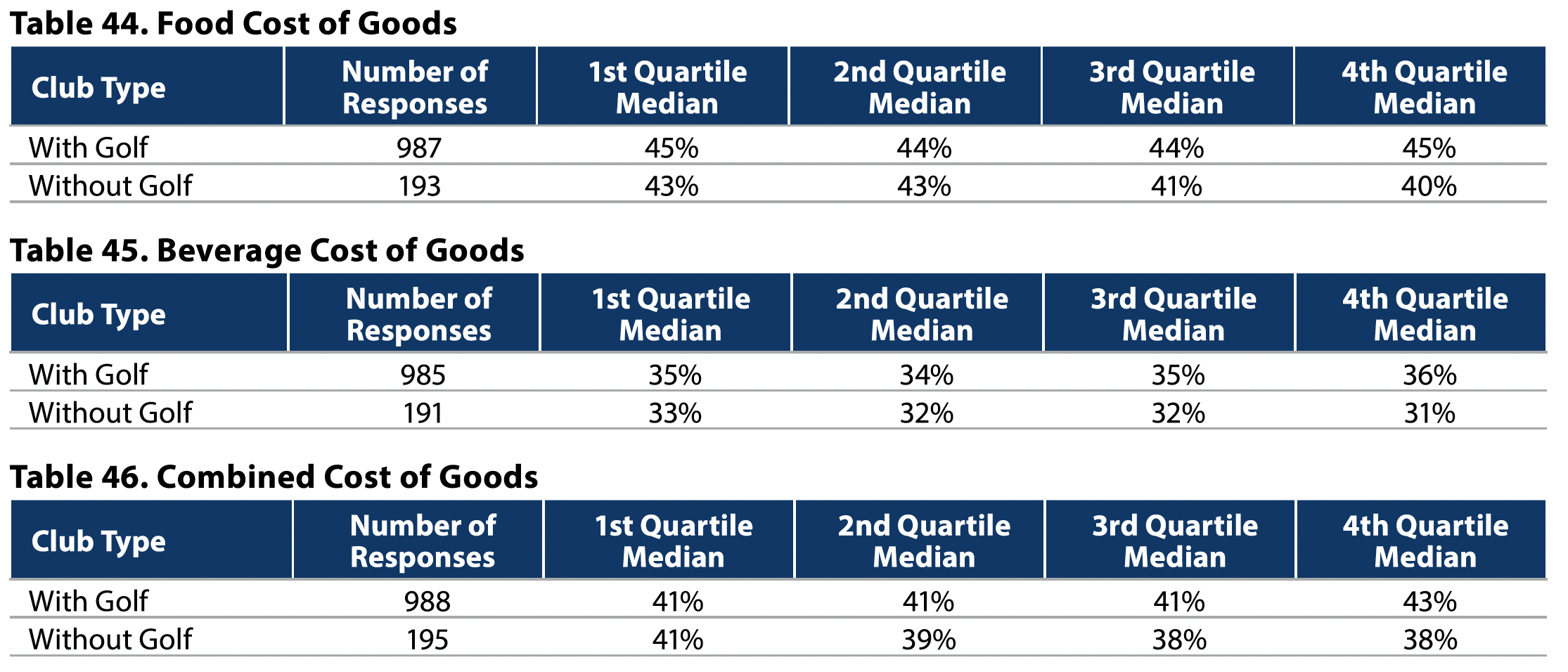
Tables 44-46 present the distribution of F&B Cost of Goods Sold across 1,180 clubs for food and 1,176 clubs for beverage. These metrics reflect the direct costs associated with delivering F&B services, excluding employee meals, minimum spend revenue, and bulk wine sales.
The Total F&B Labor Cost as a Percentage of F&B Revenue is a key operating metric that ties together club culture, service quality, and financial strategy. This distribution is shown in Table 47.

Upper Quartile Clubs:
Tend to prioritize high-quality service and amenities, reflected in higher labor-to-revenue ratios. These clubs typically have:
- More members
- Higher dues revenue
- Higher initiation fees. Their focus is on delivering a superior member experience, not maximizing departmental profit.
Lower Quartile Clubs:
Often operate with a cost-control mindset, aiming to generate profit from F&B. These clubs tend to have:
- Fewer members
- Lower dues revenue
- Lower initiation fees. Their approach reflects a choice to treat F&B as a profit center, which may limit overall member experience.
The F&B Labor-to-Revenue ratio reflects strategic choices. Clubs must decide whether to prioritize profitability or experience, and this decision is often visible in their financial and membership outcomes.
Service Charges
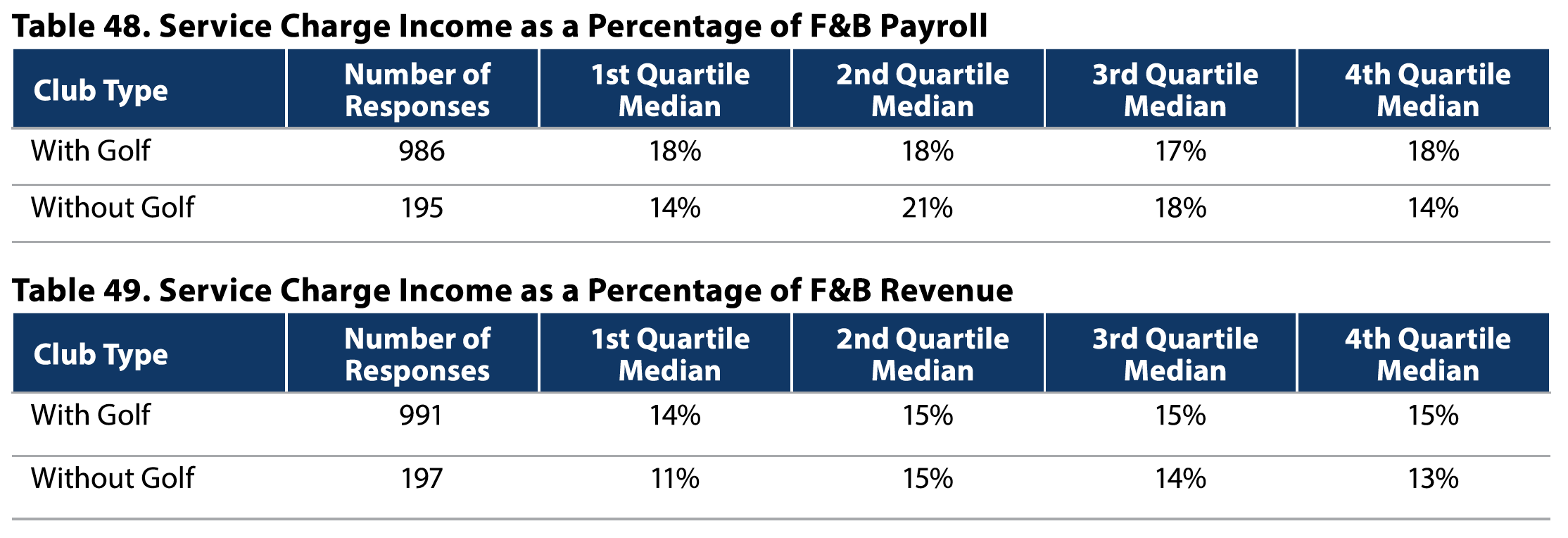
Tables 48 and 49 present the distribution of service charges across the entire industry. As with last year, there are no significant differences between Clubs with Golf and Clubs without and Service Charge Income ratios are consistent across all club sizes.
Annual Minimum Spending Requirement
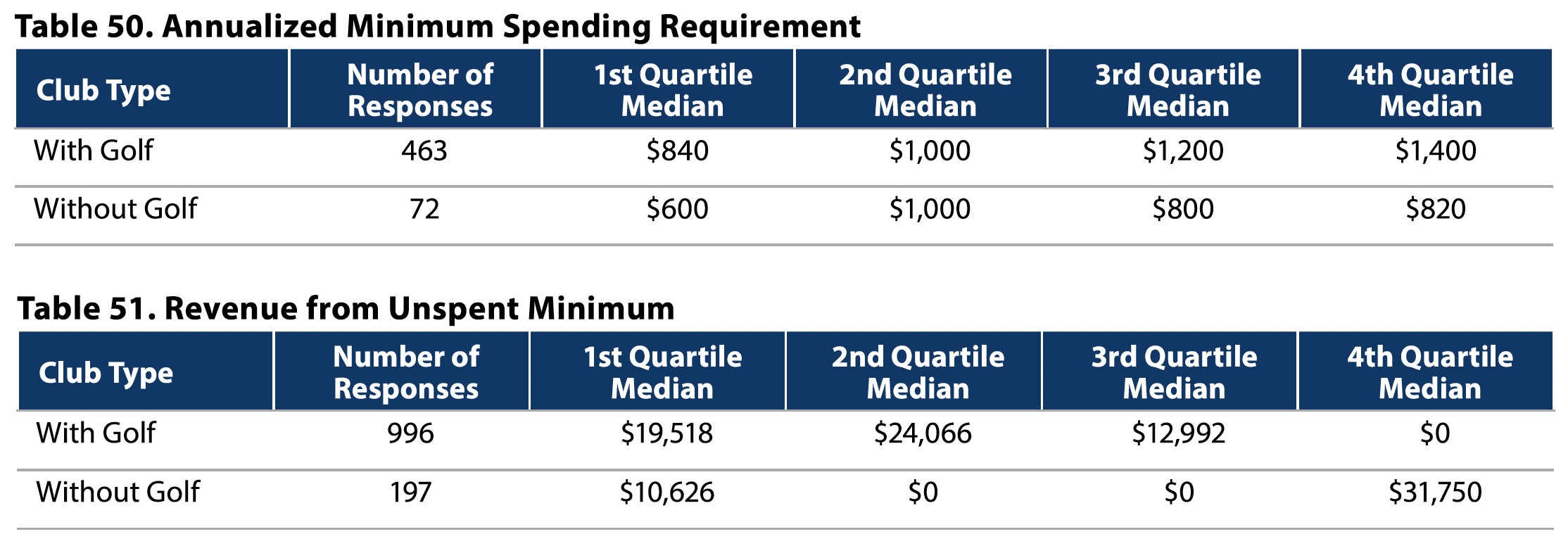
In total, 535 Clubs (463 with Golf and 72 without Golf) responded that they have a minimum spending requirement. Of all responding clubs, 48 percent of Clubs with Golf and 58 percent of Clubs without Golf reported that they do not carry an F&B minimum spending requirement.
Table 51 presents minimum F&B spending income. In clubs with golf, income from minimum spend requirements are lower as those clubs “entice” rather than “force.” The variation in data in clubs without golf is related to the smaller sample sizes.

Best Practices
Using Change to Your Advantage
In his 1988 bestseller, Thriving on Chaos: A Handbook for a Management Revolution, Tom Peters seemed to have investigated the lives of club managers when he recognized the ever-changing demands placed upon leaders with institutional scale and reach. Change, Peters observed, can be advantageous when one embraces its inevitability.
Drawing on his previous book, Passion for Excellence, Peters suggests that opportunities often reveal themselves as “problems” which can be made great opportunities.
Here are three changes that managers will be called upon to deal with in 2026 and beyond and how one may successfully use these changes for desired results:
-
Increasing Urgency for Business-Like Leadership: Club members watch their club’s leaders very carefully and judge trustworthiness and effectiveness before deciding whether they like you. One of the most frequent statements one hears while facilitating club member focus groups is, “I want the club to be run like a business.”
Decoding the several applications and meanings of this statement indicates that members recognize the necessity that their club should function with established recognized business disciplines, such as an overarching strategic plan, an annual budget, and a capital reserve plan which addresses the sources and use of funds, a comprehensive approach to running the club.
First, members evaluate their club manager for whether they are timely, organized, and professional. Second, members size up their board members/servant leaders for business background and applicable experience. Third, members watch what one does and listen to what one says.
Members consistently dismiss club leaders who fall short of members’ expectations and embrace those whose actions—more so than words—prove them not to be business-like.
Members now expect corporate disciplines for strategy, finance, and governance. Most members seem to know what their board members should be doing. Many club members question their leaders’ legitimacy for business-mindedness.
-
Cooling Demand for Private Club Memberships: For the past 16-month period, demand for membership in most clubs has slowed. In many cases, the slowing has been attributed to full member rosters and waitlists, although many clubs show declining wait times and headcounts.
Cooling in member demand elevates the significance of member retention and engagement. Club leaders who focus on member engagement—how and why members are active in their clubs—and retention—keeping current members engaged—will enjoy a successful 2026.
-
Innovative Ideas to Keep Your Club Relevant: “Relevance” may prove to be the word of the year because club leaders must successfully navigate softening membership demand and ever-increasing opportunities for seeing capable staff members being recruited to other service-sector jobs.
The “winners” of the retention game will be the clubs where fresh new programs and amenities keep members and staff.
Staff retention is a function of recognition, benefits, and proximity. Most club staff members are proud of their club employers and want to be recognized as valuable and respected and they seek employment benefits that address the increasing pressure on healthcare costs and drive time or distance from their homes to the club.
For retaining members, two keys stand out: recognition and being “somebody” is important to club members where individual validation is important and relevance is a function of the club’s engagement—at an emotional level—with its members.
Change and the unexpected create a fertile opportunity for alert club leaders.
Best Practices by Henry DeLozier, Partner, GGA Partners

External & Governmental Influences
House of Representatives Approves Sunshine Protection Act
On July 14, the House of Representatives approved the Sunshine Protection Act (HR139/S29). This legislation was first introduced in 2025 and would make Daylight Savings Time (DST) the new permanent standard time. It would end the semiannual clock adjustments—springing forward one hour each March and falling back one hour each November.
Proponents of the legislation argue that extended daylight in the evening would mean more time for outside activities like golf, tennis, swimming, etc., thus resulting in increased economic activity. DST was last adjusted in 2005 to begin one month earlier, March vs. April.
States who have previously opted out of DST, including Arizona and Hawaii, would not be impacted by the change. Other states could opt out as well before the measure becomes effective. However, more than 19 individual states have passed legislation to adopt DST as permanent. The implementation of these individual measures has been on hold due to the overriding federal standard.
The legislation now awaits action by the US Senate. The immediate outlook for adoption before the next scheduled time change is unclear. However, the current administration has voiced support for the change.
Podcast Spotlight
The Story Behind the Glass
In this episode of the Let’s Talk Club Management podcast, we’re joined by Stephanie Gallo, Gallo’s Chief Marketing Officer. We talk balancing tradition with evolving consumer expectations, especially in clubs where members value both heritage and new experiences, the trends we are seeing in wine preferences right now, and how technology can be used to improve wine education, service, and storytelling for members.

CMAA News & Announcements
Nominations for the 2026 Club Executive of the Year Nominations Due September 10
Do you know a club management professional who sets the standard for excellence? It’s time to recognize and honor their contributions! Annually, CMAA’s Club Management honors a high-performing club management professional who exemplifies excellence in leadership with the Club Executive of the Year Award. Created more than 40 years ago as the Club Manager of the Year Award, today the distinction specifically recognizes top-level executives whose sustained contributions have significantly impacted their clubs, community, and the broader profession.
Help us honor an extraordinary club management professional who raises the bar in club management and within the CMAA community. CMAA welcomes and encourages nominations from diverse backgrounds and work experiences.
Please review the full criteria, nomination packet requirements, judging process, and notification information available online. All nomination materials must be received by September 10.