
Board Brief
July 2026
Designed for Club Board of Directors

Inside this Issue:
-
Insights: Teamwork Is Job Number One
“Attitude reflects leadership…” as said by “Big” Julius Campbell to his Titans teammate Gerry Bertier in the big-screen sports drama entitled Remember the Titans. -
By the Numbers: How Membership Impacts Finance & Operations
Using data from the 2024 Club Finance and Operations Survey, we dive into understanding club membership data, including member counts, turnover, age demographics, and the financial cost of joining and maintaining memberships. -
Best Practices: The Annual Board Self-Evaluation: A Missed Opportunity at Most Clubs
Most club boards evaluate management performance, financial results, capital projects, and member satisfaction with discipline and regularity. -
External & Governmental Influences: Congress Revives Adoption of Permanent Daylight Savings Time
On May 21, the House of Representatives Energy and Commerce Committee passed a measure as part of a transportation funding bill that would make Daylight Savings Time (DST) permanent. -
Podcast Spotlight: Advocacy in Action
In May, a record number of CMAA representatives gathered in Washington, DC, to participate in the 18th Annual National Golf Day. -
CMAA News & Announcements: Call for Nominations for the 2026 Club Executive of the Year
Annually, CMAA’s Club Management magazine honors a high-performing club management professional who exemplifies excellence in leadership with the Club Executive of the Year Award. -
CMAA News & Announcements: Prepare for Success at the July 22 Governance & Leadership Symposium
CMAA’s next Governance & Leadership Symposium on July 22 offers accessible, collaborative, virtual education for club Board of Directors and club executive.

Insights
Teamwork Is Job Number One
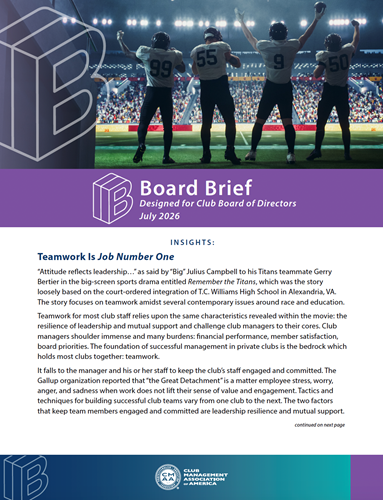
“Attitude reflects leadership…” as said by “Big” Julius Campbell to his Titans teammate Gerry Bertier in the big-screen sports drama entitled Remember the Titans, which was the story loosely based on the court-ordered integration of T.C. Williams High School in Alexandria, VA. The story focuses on teamwork amidst several contemporary issues around race and education.
Teamwork for most club staff relies upon the same characteristics revealed within the movie: the resilience of leadership and mutual support and challenge club managers to their cores. Club managers shoulder immense and many burdens: financial performance, member satisfaction, board priorities. The foundation of successful management in private clubs is the bedrock which holds most clubs together: teamwork.
It falls to the manager and his or her staff to keep the club’s staff engaged and committed. The Gallup organization reported that “the Great Detachment” is a matter employee stress, worry, anger, and sadness when work does not lift their sense of value and engagement. Tactics and techniques for building successful club teams vary from one club to the next. The two factors that keep team members engaged and committed are leadership resilience and mutual support.
Four overarching factors contribute to building and sustaining great teamwork in a private club:
Shared Vision: Club staff members—like members of most teams—must have a shared understanding of what is meant for the team to accomplish. Successful club managers share three important practices:
- Simply stated goals and objectives.
- Keeping score with regular updates.
- Role-modelled determination.
Constant Training: A manager’s commitment to investing in staff training shows staff members that their work is valuable and important to members’ overall enjoyment of the club. Staff members benefit most from four sources of training:
- Learning and developing technical skills.
- Hands-on demonstration of tricks-of-the-trade knowledge transferred from managers and coworkers.
- Recognition by coworkers and members-at-large of a job well-done.
- Frequent performance evaluations by supervisors, coworkers, and from member feedback.
Categorical Excellence: Staff members take pride in the capabilities and success of the whole team. Few teammates celebrate their category of success when the team is not performing well overall. Thus, each category of the club team’s activity must achieve high levels of success for the team to consider itself to be a winning team.
Continuous Improvement: No matter how capable, successful, and celebrated the team may be, there is always the uniting value of improvement. Calling on your team to improve continuously unites them and enables cross-functional support and durability. It prepares teammates to step in and step up whenever adversity is encountered.
Leadership that is dedicated to the four principles shown above creates a sense of personal and professional value, esprit de corps, and resilience that makes your team rise to great challenges and difficulty. Teamwork is truly job number one and it reflects the quality of leadership.
Insights by Henry DeLozier, Partner, GGA Partners

By the Numbers
How Membership Impacts Finance & Operations
From July 2024-June 2025, CMAA and Club Benchmarking collected data from more than 1,200 clubs for the 2024 Club Finance and Operations Survey. In this edition of Board Brief, we dive into understanding club membership data, including member counts, turnover, age demographics, and the financial cost of joining and maintaining memberships.
Membership Statistics

Table 26 shows that clubs with higher operating revenue tend to have higher total member counts across all categories.
To drive “apples to apples” comparison and key ratios on a per member basis, Full Member Equivalents (FME) is applied. FME is calculated by dividing the total membership operating dues revenue by the annual dues for the “full membership” category as defined by CB and in the CMAA Universal Key Club Performance Indicators White Paper (FME = Total Dues Revenue/Full Member Annual Dues).

Operating revenue excludes capital income (e.g., initiation fees, capital dues, assessments). Larger clubs generate more operating revenue per FME due to economies of scale and broader service offerings.
Membership Turnover Statistics
Table 29 shows data focused only on turnover in the “Full or Unrestricted” membership category. Across all four quartiles, Clubs with Golf have slightly less Full Member turnover than Clubs without Golf. The turnover measurement is based on member exits and/or downgrades to lower categories (Turnover=Full Member Exits and Downgrades/Total Full Members).

Age of Membership

Cost of Membership
This analysis is based on the “Family Case” scenario, which includes a primary member, spouse, and three children (ages 9, 12, and 16). It covers:
- Initiation Fees
- Annual operating dues
- F&B minimum spend requirements
- Recurring capital dues
Initiation Fees

Table 31 shows the distribution of initiation fees for clubs with and without golf, respectively.
Larger clubs tend to charge higher initiation fees to fund future capital improvements.
Membership Dues and Recurring Fees
The data presented below shows the Full Member Annual Operating Dues, with larger clubs charging more in annual dues fees.
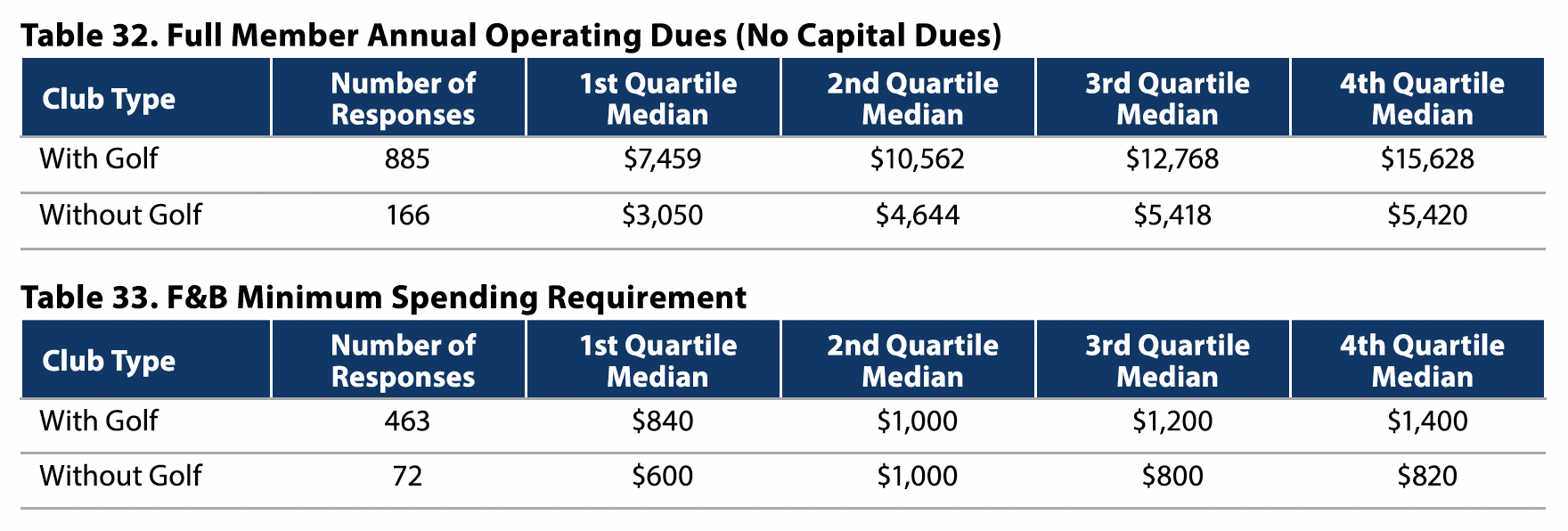
Table 33 indicates that, unlike findings in last year’s report, there are few differences in minimum spending requirements across clubs of varying sizes. Only about 50 percent of clubs reported having a F&B minimum spending requirement, a topic explored further in Table 50.

Table 34 shows a year-over-year increase in Recurring Capital Dues across all club sizes, signaling a growing recognition that capital dues are essential for funding future improvements and sustaining the member experience.
Key Metrics from Member Surveys
Net Promoter Score (NPS):
- Scale: -100 to +100
- Industry Median: 40.43
Other satisfaction metrics (based on a seven-point Likert scale):
- Overall Satisfaction
- Perceived Value
- F&B Satisfaction
- Communications Satisfaction
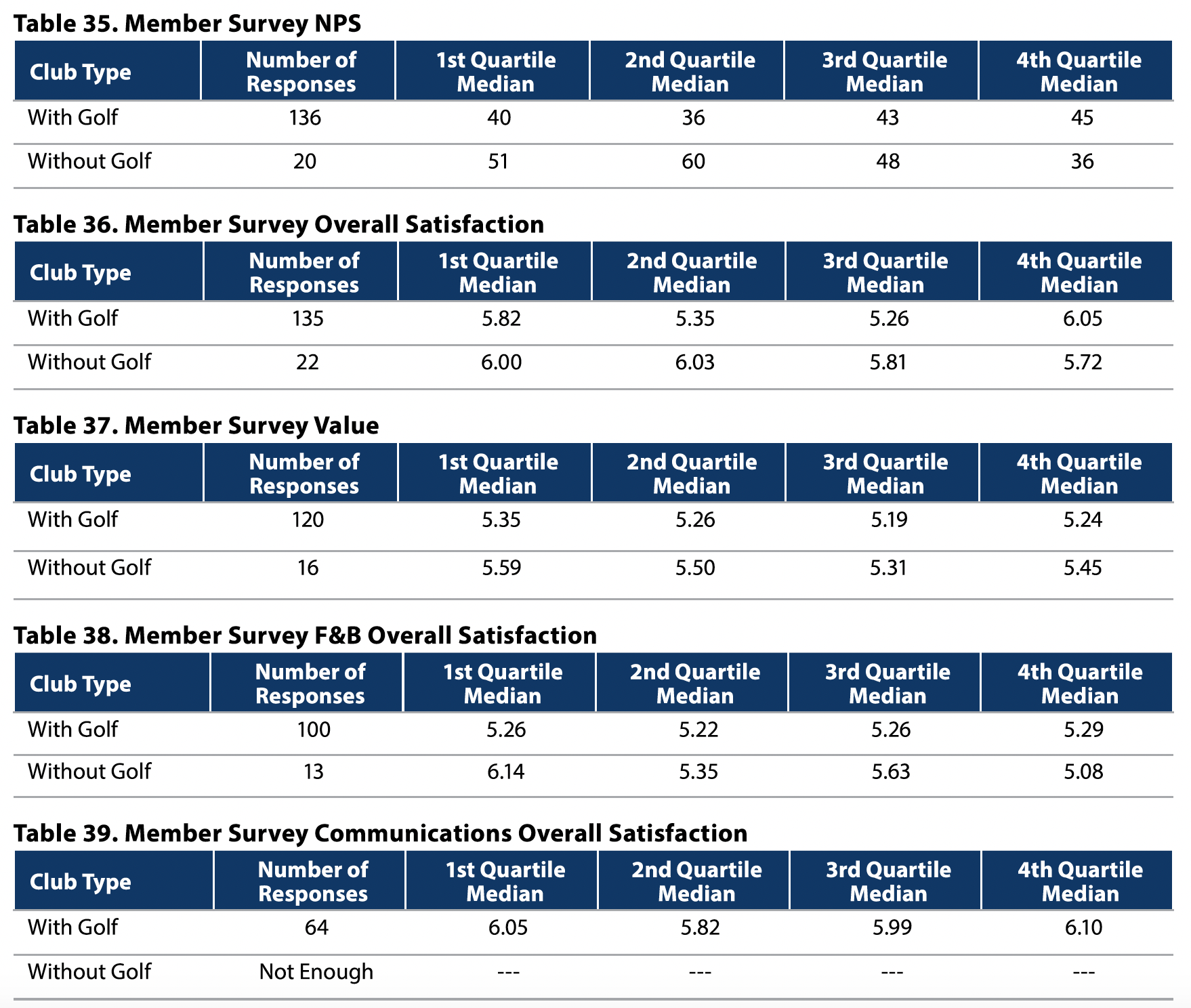
While these metrics may not directly align with financial performance, they offer critical qualitative insights for clubs that invest in understanding and responding to member feedback.

Best Practices
The Annual Board Self-Evaluation: A Missed Opportunity at Most Clubs
Most club boards evaluate management performance, financial results, capital projects, and member satisfaction with discipline and regularity. Yet one of the most valuable governance tools available to a board is often overlooked or reduced to a formality: the board’s own annual self-evaluation.
High-performing boards understand a simple truth. Governance effectiveness does not improve automatically with good intentions or experience. It improves through intentional reflection, candid discussion, and a willingness to refine how the board operates. Unfortunately, many clubs either skip this process entirely or conduct a superficial review that produces little more than polite affirmations. When that happens, boards miss an opportunity to strengthen leadership effectiveness, clarify roles, and improve strategic focus.
A meaningful self-evaluation is about alignment, not criticism.
When conducted thoughtfully, it allows directors to step back from individual agendas and consider the board’s collective performance. Are meetings focused on strategy or drifting into operations? Do directors receive information early enough to make informed decisions? Are committees functioning effectively, or duplicating management’s work? Is the board supporting or unintentionally constraining the General Manager’s authority?
Without an intentional pause for reflection, these questions often go unasked. Over time, small inefficiencies become habits, and habits become culture.
Strong boards treat self-evaluation as a governance best practice, not an administrative exercise. Effective reviews typically examine:
- Clarity of roles between board and management
- Meeting effectiveness and agenda discipline
- Quality and timeliness of information
- Strategic focus versus tactical involvement
- Board composition, skills, and succession planning
- Trust, communication, and decision-making dynamics
In many clubs, this process reveals a simple but important insight. Board meetings often become consumed by operational updates rather than strategic discussion. A small shift in structure, such as moving operational reporting to pre-read materials and reserving meeting time for strategic topics, can significantly improve board effectiveness.
Importantly, the evaluation process should be confidential, candid, and structured in a way that encourages honest input. Many clubs find value in using an external facilitator or standardized assessment tool to ensure objectivity and create space for meaningful discussion.
The greatest benefit of a board self-evaluation is not the document produced at the end. It is the conversation that follows. Those discussions often surface blind spots, strengthen alignment, and renew a shared commitment to governance excellence.
Clubs invest heavily in facilities, amenities, and long-range plans. Yet governance is the framework through which every strategic decision flows. When boards take the time to evaluate their own effectiveness, they are strengthening the leadership capacity of the entire organization.
Best Practices by Rob Schlingmann, CCM, CCE, CAM, Senior Club & Community Consultant, Strategic Club Solutions

External & Governmental Influences
Congress Revives Adoption of Permanent Daylight Savings Time
On May 21, the House of Representatives Energy and Commerce Committee passed a measure as part of a transportation funding bill that would make Daylight Savings Time (DST) permanent. The language mirrors the Sunshine Protection Act (HR139/S29), first introduced in 2025. It would make DST the new permanent standard time and end the semiannual clock adjustments—springing forward one hour each March and falling back one hour each November.
Proponents of the legislation argue that extended daylight in the evening would mean more time for outside activities like golf, tennis, swimming, etc. thus resulting in increased economic activity. DST was last adjusted in 2005 to begin one month earlier, March vs. April.
States who have previously opted out of DST, including Arizona and Hawaii, would not be impacted by the change. Other states could opt out as well before the measure becomes effective.
However, more than 19 individual states have passed legislation to adopt DST as permanent. The implementation of these individual measures has been on hold due to the overriding federal standard.
The bill will now need to be considered by the entire House of Representatives. The Senate version of the bill remains awaiting consideration in the Senate Committee on Commerce, Science, and Transportation.
The immediate outlook for adoption before the end of the year is unclear. However, the current administration has voiced support for the change.
Podcast Spotlight
Advocacy in Action
In May, a record number of CMAA representatives gathered in Washington, DC, to participate in the 18th Annual National Golf Day. In this episode of the Let’s Talk Club Management podcast, we’re joined by two of CMAA’s participants: Cameron Walker from NC State University Club in Raleigh, NC, and Christopher Storelli from Isleworth Golf & Country Club in Windermere, FL. Each shares their perspectives on participating in National Golf Day for the first time and what the experience was like from top to bottom.

CMAA News & Announcements
Call for Nominations for the 2026 Club Executive of the Year
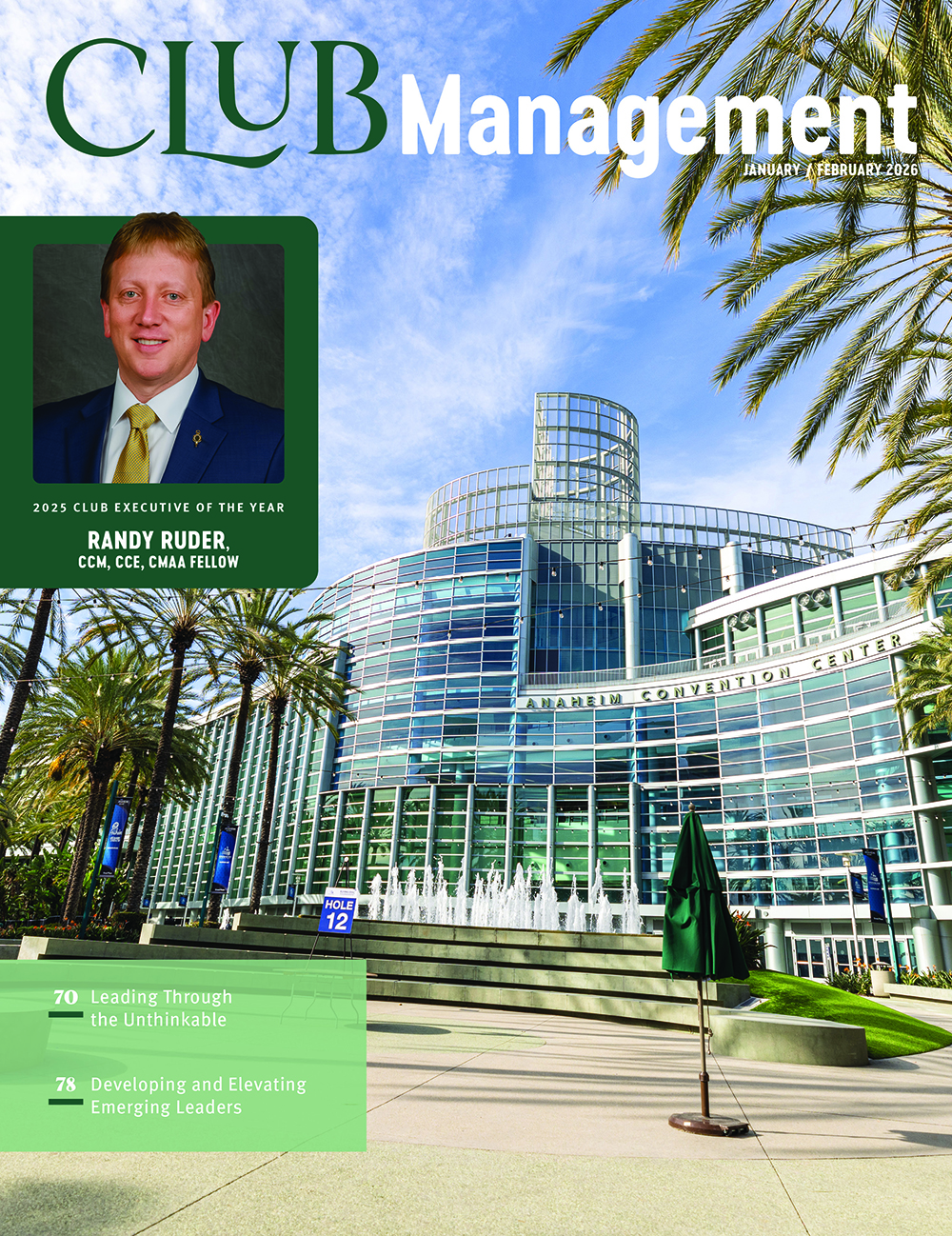
Annually, CMAA’s Club Management magazine honors a high-performing club management professional who exemplifies excellence in leadership with the Club Executive of the Year Award. Created more than 40 years ago as the Club Manager of the Year Award, today the distinction specifically recognizes top-level executives whose sustained contributions have significantly impacted their clubs, community, and the broader profession.
Help us honor an extraordinary club management professional who raises the bar in club management and within the CMAA community. CMAA welcomes and encourages nominations from diverse backgrounds and work experiences.
Please review the full criteria, nomination packet requirements, judging process, and notification information available online. All nomination materials must be received by September 10.

Prepare for Success at the July 22 Governance & Leadership Symposium
CMAA’s next Governance & Leadership Symposium on July 22 offers accessible, collaborative, virtual education for club Board of Directors and club executive. Attend from anywhere with an Internet connection.
Past attendees highly rate these sessions. John Wilkening, CCM, shared “The Governance & Leadership Symposium should be required education for all incoming Board members as well as any club management profession.”
Explore important strategic governance topics built on the principles of:
- Informed Leadership
- Strategic Stewardship
- Empowered Management and Staff
- Compelling Member Experience
Leave this symposium more informed and equipped with key takeaways for improving club governance. The Symposium is presented in partnership with KOPPLIN KUEBLER & WALLACE, a CMAA Executive Partner.